
 Fans
Fans
 Switches & Accessories
 Led Lighting
 Wires & Cables
 Switchgear
BLDC Fan vs Normal Fan: Working Principle, Power Savings, and Cost Comparison
Introduction :
Ceiling fans are an essential part of every household, running continuously for long hours to keep living spaces comfortable. With rising electricity costs, many homeowners are re-evaluating their choice of home appliances. A major point of debate during home renovations or new purchases centers on choosing a BLDC fan vs normal fan. While standard induction ceiling fans have been the traditional choice for decades, advanced Brushless Direct Current technology has completely transformed residential ventilation.
When you compare ceiling fans across modern retail categories, understanding how motor design influences everyday electricity bills, motor heating, and long-term durability is essential. Fybros manufactures precision-engineered fans that combine reliable performance with cutting-edge motor efficiency. Evaluating a BLDC fan vs normal fan in terms of initial cost, power consumption, and operating features helps you select the right cooling setup for your household.
Quick Comparison: BLDC Fan vs Normal Induction Fan (Feature Matrix)
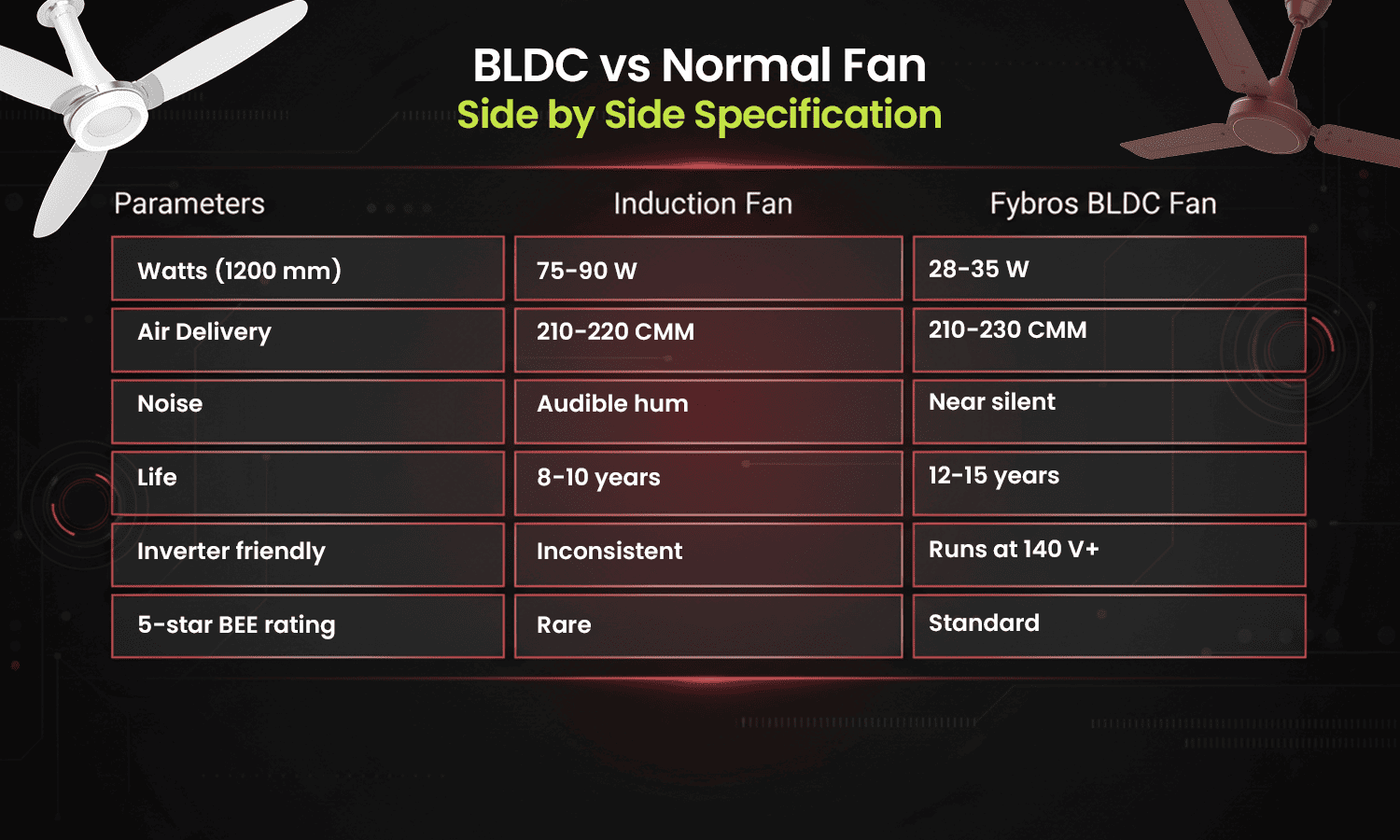
Selecting between traditional induction technology and modern brushless motors becomes straightforward when comparing their technical specifications side-by-side.
Side-by-Side Specifications Table
|
Feature/Specification |
BLDC Ceiling Fan |
Normal AC Induction Fan |
|
Motor Type |
Brushless Direct Current (BLDC) |
Single-Phase AC Induction |
|
Power Consumption |
28 W to 35 W |
75 W to 80 W |
|
Speed Control |
Smart RF/IR Remote Control |
Wall-Mounted Resistance/Step Regulator |
|
Inverter Runtime |
Up to 3 times longer on home inverter |
Standard backup duration |
|
Voltage Fluctuation Range |
Smooth operation from 110 V to 285 V |
Speed drops or hums under low voltage |
|
Operational Noise |
Noiseless, whisper-quiet performance |
Audible electrical humming at lower speeds |
|
Motor Heat Generation |
Minimal heat generation due to no mechanical friction |
High internal heat build-up over long runs |
|
Power Factor |
High power factor (close to 0.98) |
Lower power factor (0.6 to 0.7) |
Key Takeaways at a Glance
-
Massive Power Reduction: Evaluating a BLDC ceiling fan vs normal ceiling fan reveals an immediate reduction in electricity consumption, cutting power draw by up to 60 percent.
-
Convenient Control: BLDC fans eliminate the need for traditional wall regulators, relying on multi-functional remotes with sleep timers and boost modes.
-
Consistent Speed: Built-in microcontrollers maintain a constant RPM even during severe voltage drops, preventing annoying speed drops during peak hours.
Technical Differences: How BLDC Motors Compare to Induction Motors
The operational difference when evaluating a BLDC fan vs normal fan lies within the internal motor architecture. Both system types convert electrical energy into mechanical movement, but they accomplish this through entirely different physical principles.
Knowing how these motors function highlights why brushless technology offers superior energy conversion efficiency compared to standard induction setups.
Working Principle of BLDC (Brushless Direct Current) Motors
A BLDC motor operates on direct current using an electronic commutator instead of mechanical brushes or induction coils. The fan receives alternating current (AC) from your home socket, which an internal switched-mode power supply (SMPS) converts into direct current (DC).
A smart electronic controller then directs current through the motor stator windings, driving high-grade permanent magnets embedded in the rotor. Because magnetic attraction and repulsion are managed electronically without carbon brushes or physical contact, mechanical friction is eliminated, preventing energy loss as excess heat.
Working Principle of Normal AC Induction Motors
Standard ceiling fans rely on single-phase AC induction motors. When alternating current flows through the stator coils, it creates a rotating magnetic field. This field induces an electric current in the rotor, generating electromagnetic force to turn the fan blades.
Because this process relies entirely on induction across copper windings, continuous resistance generates substantial heat. Additional current is lost overcoming internal friction, making standard induction motors noticeably less energy efficient.
Power Consumption Comparison (28W–35W vs 75W–80W)
The most striking difference between a BLDC vs normal fan is total wattage draw. A standard induction fan consumes roughly 75 W to 80 W on high speed, with older units drawing even more as internal components age.
In contrast, a modern BLDC fan like the Fybros Casa BLDC operates at just 28 W to 32 W while delivering full air thrust. Even across various BLDC fan sizes, including 900 mm, 1200 mm, and 1400 mm models, power consumption remains low. Over months of continuous daily use, this stark wattage difference translates directly into noticeable savings on your electricity bill.
Electricity Bill Savings Calculation: Is a BLDC Fan Worth It?
When buyers compare ceiling fan price figures in retail stores, BLDC models carry a higher initial price tag than basic induction units. However, evaluating a BLDC fan vs normal fan requires looking beyond the initial purchase price to consider long-term operating costs.
Calculating actual power usage demonstrates how quickly a high-efficiency fan pays for itself.
Daily and Annual Power Consumption Math (kWh & Units)
Let us examine a real-world scenario where a ceiling fan runs for 12 hours every day at full speed, assuming an electricity tariff of 8 INR per kWh unit:
-
Normal Induction Fan (75 W):
-
Daily energy used = 75 W x 12 hours = 900 Wh = 0.9 kWh (units)
-
Daily cost = 0.9 units x 8 INR = 7.20 INR
-
Annual cost = 7.20 INR x 365 days = 2,628 INR per fan
-
-
Fybros BLDC Fan (32 W):
-
Daily energy used = 32 W x 12 hours = 384 Wh = 0.384 kWh (units)
-
Daily cost = 0.384 units x 8 INR = 3.07 INR
-
Annual cost = 3.07 INR x 365 days = 1,120 INR per fan
-
-
Annual Savings: Running a BLDC unit saves approximately 1,508 INR per fan every year.
Financial Payback Period and ROI per Fan
When you compare ceiling fan price points, a premium BLDC fan typically costs between 1,200 INR and 1,800 INR more upfront than a basic induction model. Given the annual electricity savings of over 1,500 INR calculated above, the entire price difference is recovered in under 15 to 18 months of routine use.
Beyond this initial payback window, every year of operation delivers pure financial savings, delivering an exceptional return on investment over the fan's lifespan.
Reliable Performance on Inverters and in Low-Voltage Areas
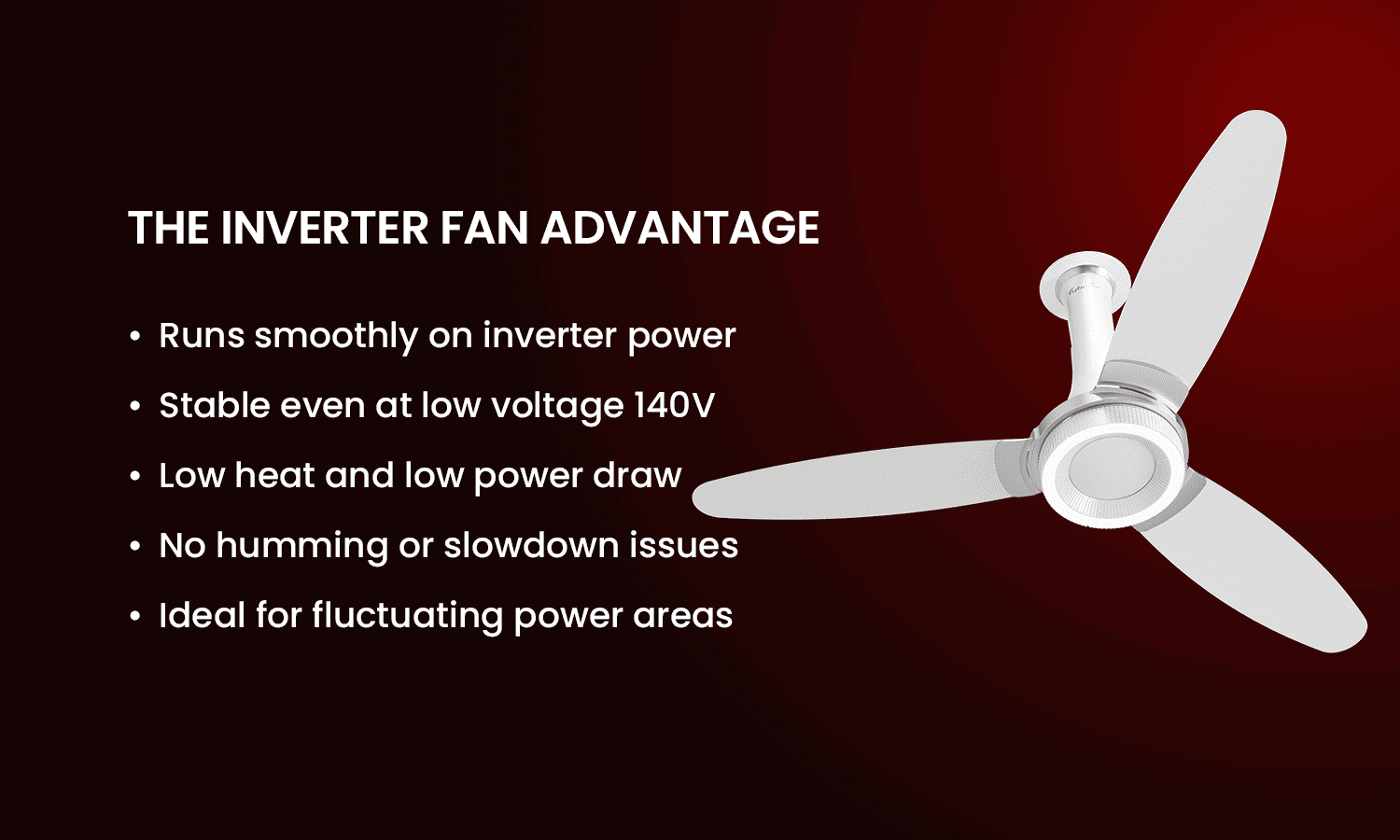
For households in regions prone to frequent power cuts or voltage fluctuations, a BLDC fan's inverter compatibility is a major advantage. Because these motors draw such little power, they run smoothly on inverter backup without the strain that normal induction fans place on batteries. Even when grid voltage dips as low as 140 V, a BLDC fan continues operating at full, stable speed, with no humming, flickering, or sudden slowdown. This makes it a dependable choice for homes in areas with fluctuating power supply, ensuring consistent airflow and comfort regardless of grid conditions.
Inverter Backup Performance (3x Runtime Comparison)
In areas subject to frequent load shedding, long power cuts can drain home inverter batteries quickly. Because a standard fan draws 75 W, running multiple fans simultaneously places a heavy load on battery systems.
A 30 W BLDC fan consumes less than half the power, extending total home inverter backup time by up to three times. This allows your inverter to power essential lights and fans for hours without completely draining battery reserves.
Operational Differences & Feature Breakdown
Evaluating a BLDC ceiling fan vs normal ceiling fan reveals significant functional benefits beyond power savings, enhancing daily home comfort.
Smart Remote & Speed Control vs Wall Regulator Usage
Traditional fans use wall regulators that wear out and cause humming noise at low speeds. Fybros BLDC fans feature a smart wireless remote app to effortlessly change speeds, set sleep timers, toggle LED lights, or switch to boost mode from anywhere in the room.
Wide Voltage Fluctuation Performance (110V – 285V Range)
Grid voltage drops cause standard fans to lose speed and hum loudly during peak hours. Fybros BLDC motors use smart microcontrollers that regulate input power, maintaining full speed across a wide range of 110 V to 285 V without performance loss or thermal stress.
Motor Heating, Friction, Noise, and Long-Term Durability
Unlike standard AC induction motors that generate excessive heat and wear out over time, BLDC motors operate without carbon brushes or physical friction. This heat-free, quiet operation reduces wear on internal bearings, delivering whisper-quiet performance and a much longer product lifespan.
FAQs
1. How much electricity does a BLDC fan save compared to a normal fan?
A BLDC fan consumes only 28 to 35 W compared to 75 to 80 W for a normal fan, saving up to 60 to 65 percent on electricity consumption.
2. Can I operate a BLDC fan using a standard wall regulator?
No, BLDC fans are controlled using smart wireless remotes or smart devices rather than traditional wall regulators.
3. Do BLDC fans perform better on home inverters during power cuts?
Yes, because BLDC fans draw less than half the power of traditional fans, they can run up to three times longer on an inverter battery.
4. How long does it take for a BLDC fan to recover its higher upfront cost?
Through monthly electricity bill savings, a BLDC fan typically recovers its price difference within 12 to 18 months of routine daily use.