
 Fans
Fans
 Switches & Accessories
 Led Lighting
 Wires & Cables
 Switchgear
Ceiling Fan Dimensions & Measurement Guide: How to Measure Fan Sizes in MM & Inches
Ceiling fan sizes play a crucial role when selecting the right cooling solution for your home, requiring a clear understanding of room proportions and physical space constraints. Choosing among different ceiling fan sizes is not just a matter of visual appeal; it directly dictates how effectively air circulates throughout your living space. An oversized fan in a compact room can create an overwhelming draft, while an undersized unit in a spacious hall will struggle to move air efficiently.
When evaluating your options, reviewing the complete ceiling fan dimensions helps you match motor power and sweep area with your exact architectural layout. Fybros manufactures precision-engineered fans designed to offer optimal air delivery across a wide range of living environments. By learning how sweep diameter is calculated and how blade pitch affects air movement, you can make an informed investment that enhances both comfort and energy efficiency.
How to Measure Ceiling Fan Size Correctly (Blade Sweep Math)
Accurate ceiling fan measurement relies on calculating the total blade sweep, which is the diameter of the circle formed by the tips of the blades when the fan is in full motion. Many homeowners mistakenly measure only the length of a single blade, leading to incorrect sizing decisions.
Understanding the math behind different ceiling fan sizes ensures that you purchase a unit that fits your ceiling layout and mounting points perfectly. The physical measurement technique varies depending on whether your fan features an even or odd number of blades.
Measuring Even-Blade Fans (2-Blade & 4-Blade)
Measuring a fan with an even number of blades is simple and straightforward. Because the blades sit directly opposite each other, you can calculate the sweep diameter by taking a direct straight-line measurement.
-
Locate the outermost tip of one blade.
-
Extend your measuring tape directly across the centre of the motor hub.
-
Continue to the outermost tip of the opposing blade.
This direct tip-to-tip distance gives you the exact sweep diameter of the fan without requiring complex math or calculations.
Measuring Odd-Blade Fans (3-Blade Fans)
Because 3-blade fans do not have opposing blades aligned in a straight line, measuring them requires a slightly different approach.
-
Measure from the center point of the motor hub to the outermost tip of one blade.
-
Take that distance and multiply it by two.
For example, if the distance from the center of the motor hub to the tip of the blade is 600 mm, multiplying by two yields a total sweep diameter of 1200 mm. Knowing your exact ceiling fan blade size using this method allows you to evaluate replacement blades or new fixtures with complete confidence.
Unit Conversion Table (MM vs Inches)
In India and many global markets, fan manufacturers specify dimensions using both metric and imperial measurements. Identifying your required ceiling fan size in mm alongside standard ceiling fan sizes in inches simplifies browsing through product catalogs.
|
Sweep Size in MM |
Sweep Size in Inches |
Ideal Room Type |
Recommended Room Area |
|
600 mm |
24 inches |
Small kitchens, walk-in closets, bathrooms |
Up to 50 sq. ft. |
|
900 mm |
36 inches |
Compact bedrooms, study rooms, utility spaces |
50 to 80 sq. ft. |
|
1200 mm |
48 inches |
Standard bedrooms, living rooms, dining areas |
100 to 150 sq. ft. |
|
1400 mm |
56 inches |
Large halls, master suites, commercial spaces |
Above 150 sq. ft. |
Blade vs 4 Blade Fan Dimensions: Airflow, Drag & Performance
When evaluating a 3 blade vs 4 blade fan, the choice extends beyond mere aesthetics. The number of blades directly impacts aerodynamic drag, motor strain, airflow output, and operational noise levels.
Comparing various ceiling fan sizes across 3-blade and 4-blade configurations reveals how blade count alters performance dynamics under daily usage conditions.
3-Blade Ceiling Fans (High Air Delivery & Speed)
Three-blade ceiling fans represent the standard design choice across residential properties in India. With fewer blades attached to the motor hub, aerodynamic drag is significantly minimized. This allows the motor to rotate at higher RPM speeds while consuming less electrical power.
Because 3-blade designs prioritize raw air displacement and rapid rotation, they are ideally suited for warmer climates where intense air movement is required. Fybros engineers 3-blade models to maximize air thrust while keeping energy consumption remarkably low.
4-Blade Ceiling Fans (Aesthetics & Whispered Airflow)
Four-blade ceiling fans offer a sophisticated, balanced appearance that complements modern interior decor. The additional blade increases total surface area, allowing the fan to move air in a softer, more distributed pattern.
While the added weight creates slightly more drag, 4-blade fans operate with less noise and reduced wind turbulence. They are popular choices for air-conditioned spaces, bedrooms, and home offices where quiet operation is valued over aggressive air thrust.
Ceiling Fan Small Size Specs
When outfitting compact spaces such as pantries, narrow corridors, or small balconies, selecting a ceiling fan of a small-sized unit prevents clutter while delivering targeted cooling.
Small fan options deliver adequate air velocity in tight spaces without overwhelming the room or creating uncomfortable drafts. Knowing how smaller ceiling fan sizes function helps you select the proper unit for utility zones.
600 mm (24 Inch) Mini Fan Dimensions
A 600 mm sweep fan is designed specifically for tight quarters where space is at a premium. With a compact blade radius, these mini fans rotate at high RPM speeds to produce a concentrated air column directly beneath the unit.
These units are ideal for small kitchens where overhead cabinets restrict space, as well as walk-in closets, pooja rooms, and balcony nooks. Choosing miniature Ceiling fan sizes keeps safety clearances intact while eliminating stagnant air pockets.
900 mm (36 Inch) Compact Fan Dimensions
The 900 mm fan serves as an effective bridge between mini fixtures and standard residential units. It offers wider coverage than a 600 mm fan while maintaining a compact footprint that easily fits smaller rooms.
These compact units work exceptionally well in study rooms, children's bedrooms, and utility areas ranging between 50 and 80 square feet. Their balanced proportions deliver consistent air distribution without dominating the ceiling area visually.
Ceiling Fan Medium Size Specs
Medium-sized ceiling fans represent the core segment of residential ventilation systems. Selecting a ceiling fan of a medium-sized model guarantees balanced airflow coverage across standard living spaces.
Most standard bedrooms, dining spaces, and home offices fall within the coverage capabilities of this category. Comparing popular ceiling fan sizes within the medium range ensures long-term comfort and optimal air movement.
Why 1200 mm (48 Inch) Is India's Default Fan Size
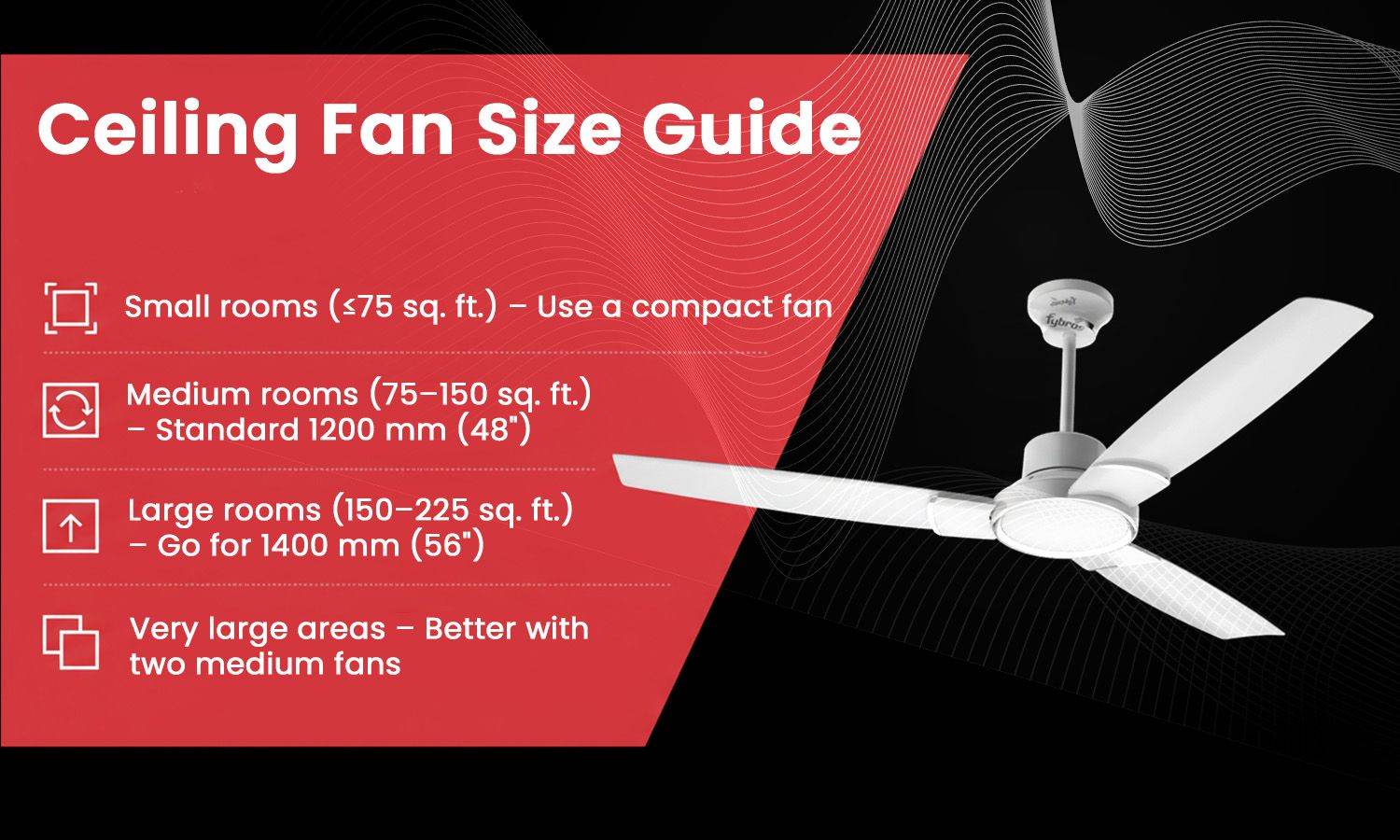
The 1200 mm sweep fan is widely considered the gold standard for Indian homes. Architecturally, most residential bedrooms and living spaces in India range between 100 and 150 square feet, making 1200 mm units the ideal proportion for maximum cooling efficiency.
A 1200 mm fan provides full-room air circulation by casting a broad sweep pattern that reaches every corner without generating excessive motor noise or consuming redundant power. Fybros offers a diverse portfolio of 1200 mm models equipped with high-grade copper motors and aerodynamically designed blades to ensure lasting reliability.To explore complete sizing charts for larger or multi-room layouts, check out our ceiling fan size guide
Downrod Clearance Specs for Medium-Size Fans
Proper installation is just as critical as selecting the right blade diameter. To achieve optimal air suction and circulation, a ceiling fan must maintain appropriate clearance distances from ceilings, walls, and floor surfaces.
For medium-sized fans installed in standard 9-foot to 10-foot ceilings, maintain the following safety clearances:
-
Floor-to-blade height: Keep a minimum clearance of 7 to 8 feet from the floor to the fan blades for safety and optimal air delivery.
-
Ceiling to blade clearance: Maintain at least 12 inches of space between the ceiling and the top of the fan blades to ensure smooth air intake.
-
Wall clearance: Ensure a minimum distance of 24 inches between the blade tips and the nearest wall or tall wardrobe.
Following these downrod clearance specifications allows your Fybros ceiling fan to draw in upper-level air efficiently, delivering powerful, uninterrupted airflow throughout your entire room.
FAQs
1. How do I measure the size of my ceiling fan?
For even-blade fans, measure tip-to-tip across the centre hub; for 3-blade fans, measure from the hub centre to one blade tip and multiply by two.
2. What is the standard ceiling fan size for a normal bedroom?
A 1200 mm (48-inch) fan is the standard choice for typical bedrooms measuring between 100 and 150 square feet.
3. Which is better: a 3-blade fan or a 4-blade fan?
A 3-blade fan provides higher speed and stronger air delivery, while a 4-blade fan offers quieter operation and smoother airflow distribution.
4. How much space should be left between the ceiling fan and the floor?
Maintain a minimum clearance of 7 to 8 feet from the floor to the blades for safety and optimal air circulation.