
 Fans
Fans
 Switches & Accessories
 Led Lighting
 Wires & Cables
 Switchgear
Ceiling Fan with Remote Control: Features, Brands & Smart Buying Tips 2026
The wall switch has had its day. In 2026, the ceiling fan with remote control is the default expectation in any premium Indian home , not a luxury add-on. The ability to adjust airspeed, toggle the integrated LED, set a sleep timer, and activate an auto-mode, all from the comfort of your sofa or bed, is fundamentally how modern families interact with their home environment. But not all remote control systems are created equal.
Why Remote Control on a Ceiling Fan with Light Matters More Than You Think
A ceiling fan with an integrated light and no remote control creates a problem: you now have two appliances to manage from one wall switch. You either sacrifice independent control of the light and fan, or you add a second switch point and complicate the wiring. A good remote solves this elegantly , one device controls both, independently, from anywhere in the room.
The impact on daily life is significant: a ceiling fan with light and remote means you adjust airflow without leaving bed at 3 a.m., dim the light for a movie without getting up, or set a sleep timer from your pillow. For families with elderly members or young children, this convenience becomes an accessibility essential.
RF vs. IR Remotes: The Technology Difference That Matters
|
Radio Frequency (RF) Remote |
Infrared (IR) Remote |
|
Works through walls and obstacles |
Requires line of sight to the fan receiver |
|
Works from any direction in the room |
Must point at the fan/receiver to function |
|
Longer effective range (up to 30 m) |
Shorter range (typically 6–10 m) |
|
More reliable in real-world conditions |
Signal blocked by furniture/people |
|
Used in all premium BLDC fan remotes |
Common in older/budget fan models |
|
Typically includes 4–6 speed settings |
Usually 3-speed only |
Expert Tip: Always choose RF remote over IR for ceiling fans in Indian homes. RF works around the room, through bedsheets, and without the precision aiming that IR requires , especially important for elderly users and nighttime use.
Key Remote Control Features to Look For in 2026
-
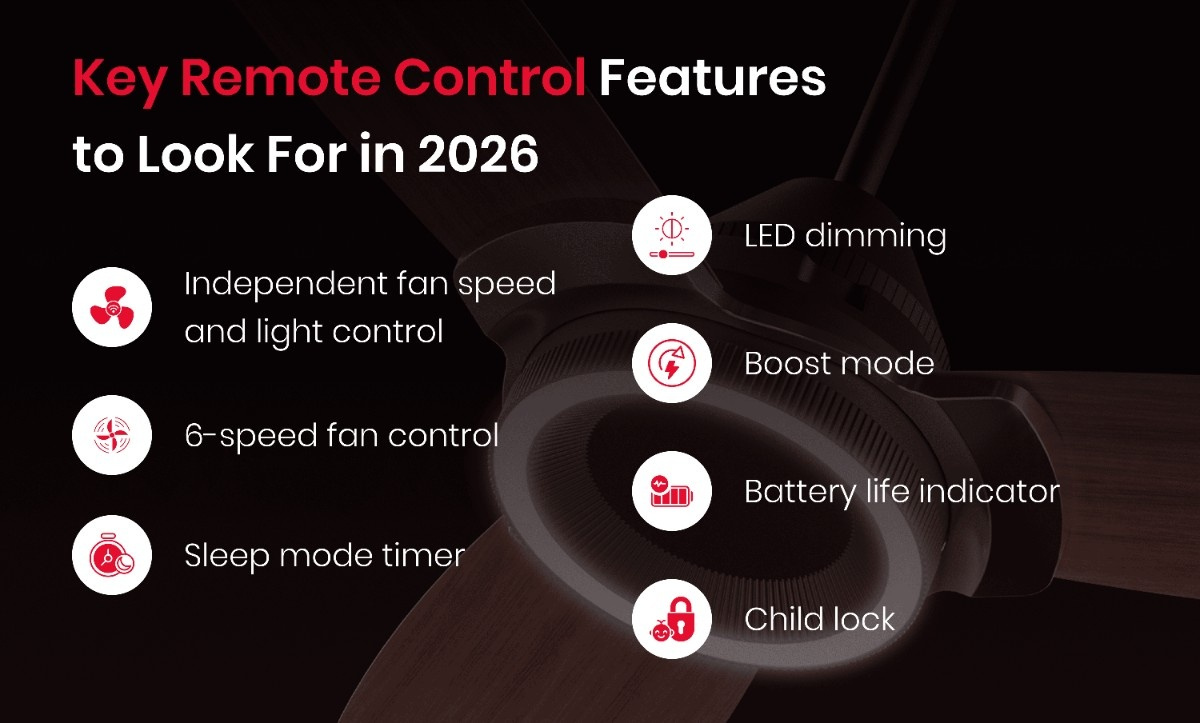
Independent fan speed and light control: Essential , must be able to switch off the light while keeping the fan running, and vice versa.
-
6-speed fan control: Finer airflow granularity versus the old 3-speed approach , especially valuable for sleep environments.
-
Sleep mode timer: Programmed to gradually reduce fan speed over 30–60 minutes, then shut off or continue at minimum speed.
-
LED dimming: Adjustable light brightness via remote , morning brightness, evening ambience, bedtime glow, all from one button.
-
Boost mode: One-touch maximum speed activation for quick cooling on hot days.
-
Battery life indicator: Visual or LED alert when remote battery is running low.
-
Child lock: Prevents accidental speed changes or light switching , essential for families with young children.
The Fybros F-Wave Remote Control System
The Fybros F-Wave Ceiling Fan ships with a purpose-designed remote control that independently manages fan speed settings and the integrated LED light. The remote uses RF technology for reliable whole-room reach , no pointing, no line-of-sight requirement. The entire Fybros Ceiling Fan range includes remote-enabled models across price points.
Pairing Remote-Controlled Fans with Smart Switches
For homeowners building a complete smart room setup, Fybros' Switches & Accessories range includes modular switches designed to work in harmony with remote-controlled fans. The Four-X and Zine switch series provide a physical backup control point while the remote handles day-to-day convenience , giving households both the reliability of a wall switch and the convenience of remote operation.
Remote Control Ceiling Fan , Feature Priority Ranking
-
1st Priority: Independent fan + light control (non-negotiable)
-
2nd Priority: RF technology (not IR) for obstacle-free range
-
3rd Priority: Sleep mode with progressive speed reduction
-
4th Priority: LED dimming function
-
5th Priority: Boost mode for fast cooling
-
6th Priority: App or voice control (smart home integration)
Smart Fan vs. Remote-Controlled Fan: Which Do You Need?
|
Remote-Controlled Fan (RF) |
Smart Fan (Wi-Fi / App / Voice) |
|
Works without smartphone |
Requires smartphone/smart speaker |
|
No Wi-Fi dependency |
Needs stable Wi-Fi or Bluetooth |
|
Simpler installation |
May need smart hub or adapter |
|
Lower price point |
Typically 30–50% premium |
|
Fully functional during internet outage |
May lose remote function if router fails |
|
Best for: standard home users |
Best for: tech-savvy smart home builders |
FAQ's
1. Can I add a remote control to an existing ceiling fan without one?
In some cases, yes , aftermarket RF receiver kits can be wired into an existing fan to add remote functionality. However, this does not add light control if the fan has no integrated LED. For best results, reliability, and warranty compliance, it is always preferable to purchase a ceiling fan with a manufacturer-integrated remote control system , like the Fybros F-Wave , rather than retrofitting one.
2. Why does my ceiling fan remote stop working?
The most common reasons are: depleted remote battery, the receiver inside the fan losing pairing, electrical interference from nearby devices, or the remote being an IR type with line-of-sight blocked. For RF remotes, check the battery first (most use a CR2032 or AA cell). If the fan has lost pairing, most models have a reset procedure described in the product manual. For persistent issues, contact Fybros customer support via fybros.com.
3. How far does a ceiling fan remote control work?
RF remotes in quality ceiling fans like the Fybros F-Wave typically operate reliably at distances of 15–30 metres through walls and obstructions. IR remotes are limited to 6–10 metres in direct line of sight. For typical Indian rooms (10–25 feet in typical dimension), both types are adequate , but RF is always the preferred technology for real-world reliability.
4. Can I use a ceiling fan remote to control both the fan and light separately?
Yes , provided the fan is designed with independent fan/light remote control circuits. The Fybros F-Wave's remote control is specifically designed to manage fan speed settings and the integrated LED independently. Not all fan remotes offer this capability , it is worth confirming in the product specification before purchasing.
5. Is a smart ceiling fan better than a remote-controlled ceiling fan for Indian homes?
Smart fans offer undeniable convenience for tech-savvy households with stable Wi-Fi and smart speaker setups. However, for the majority of Indian homes, a high-quality RF remote-controlled ceiling fan like the Fybros F-Wave provides 90% of the convenience at a more accessible price, with zero Wi-Fi dependency. A smart fan is an excellent upgrade for buyers specifically building a connected home ecosystem.