
 Fans
Fans
 Switches & Accessories
 Led Lighting
 Wires & Cables
 Switchgear
What Is a floor-standing Fan and Why It’s Still a Smart Cooling Choice?

Introduction
A floor-standing fan is one of the simplest cooling choices that still works well in Indian homes. You place it on the floor, plug it in, and point airflow exactly where you need it. No drilling, no ceiling work, and no fixed position.
People often mix terms like pedestal fan and floor fan, so let’s make it clear. A floor fan usually sits closer to the ground and gives strong directional airflow. A pedestal fan is taller and adjustable. Both can be called a floor-standing fan in everyday language, especially when the fan has a stand and base.
In this blog, you’ll understand how it works, why people still choose it, and how to use it in a way that feels comfortable day after day.
How Does a floor-standing Fan Work?
A floor-standing fan works by using an electric motor to rotate blades. The rotating blades pull air from behind and push it forward, creating airflow that helps your body feel cooler.
Here’s what happens in simple steps:
-
Electricity powers the motor.
-
The motor spins the blade shaft.
-
The blades push air in one direction.
-
If oscillation is enabled, the fan head rotates left and right to spread airflow.
Many models today are built like a floor fan with a stand, which gives better height and angle control compared to a basic floor fan that stays low. If you prefer a fan that can cover more of the room, oscillation and tilt adjustment matter more than extra buttons.
epending on your seating position. This matters a lot if you’re working at a desk or sitting on the floor.
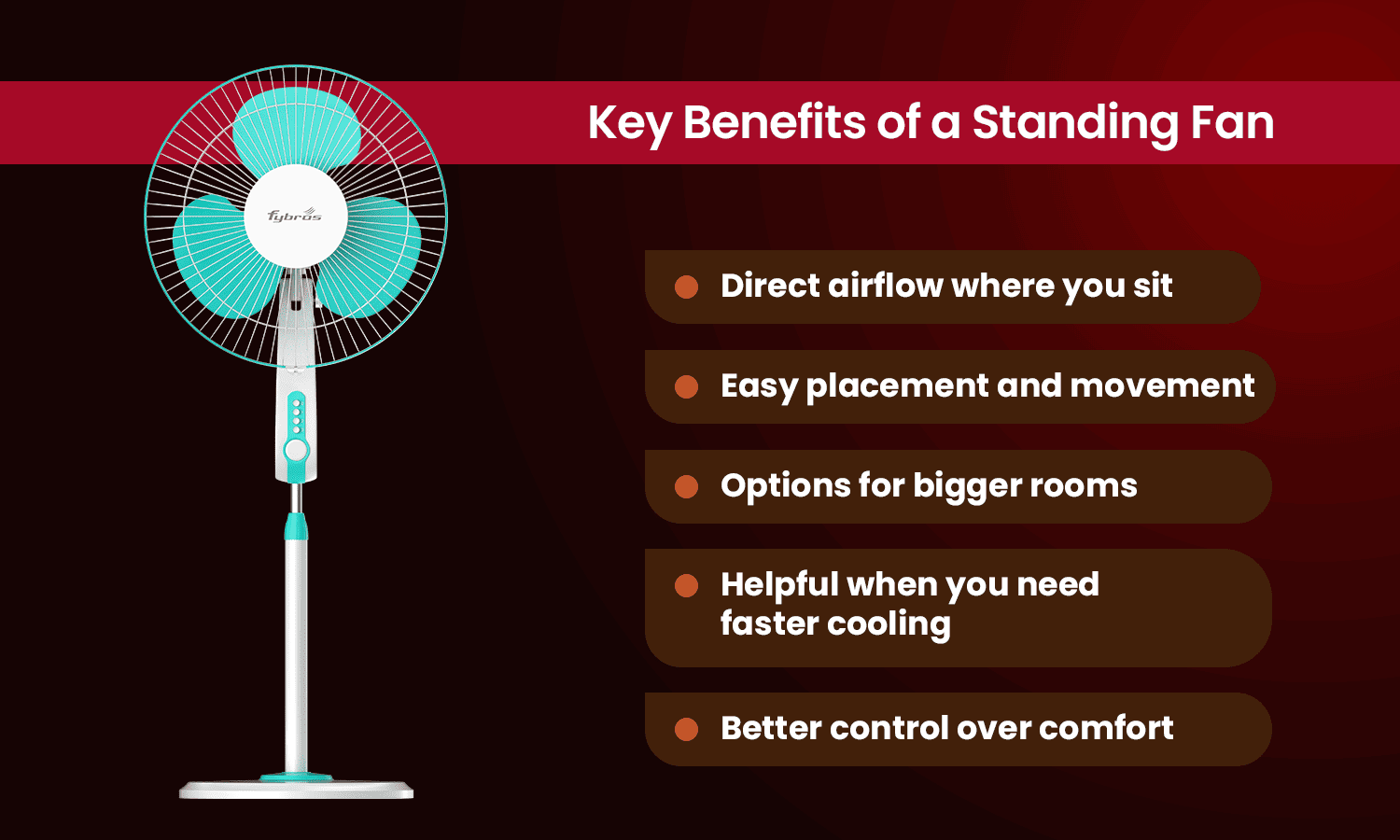
Key Benefits of a Standing Fan
Direct airflow where you sit
A floor-standing fan is great when you want focused airflow. This is useful in bedrooms, work corners, and living rooms where one area feels warmer than the rest.
Easy placement and movement
You can move it between rooms without any installation work. This is one reason why people compare it with a pedestal fan during purchase. A standing fan makes sense when you want flexibility.
Options for bigger rooms
If your room is large or you want strong airflow, a large floor fan can help. These fans usually have a wider sweep or stronger air throw, which feels better in open living spaces or halls.
Helpful when you need faster cooling
If your room heats up quickly in the afternoon, speed becomes important. Many people specifically look for pedestal fan high speed models because strong airflow feels more comfortable in hot weather. Just make sure the base stays steady at top speed.
Better control over comfort
You can aim airflow higher or lower depending on your seating position. This matters a lot if you’re working at a desk or sitting on the floor.
Applications of Standing Fans
A floor-standing fan is useful in many daily situations, not just in summer.
Living room use
In living rooms, people often want airflow that reaches more than one person. A fan with oscillation works well here. If you like darker interiors, a black pedestal fan can also match your room theme without standing out too much.
Bedrooms and night comfort
For sleep, the fan should feel steady, not harsh. Many buyers look for a silent pedestal fan, but in real life, the goal is “low and comfortable sound” rather than absolute silence. If you want a softer sound and steady airflow, focus on build quality and smooth motor running.
Work and study spaces
In work areas, airflow should not be distracting. If you already have a desk fan, you may prefer something like the quiet table fan for close seating. But if you want airflow to reach your chair and the whole corner, a floor-standing fan is often more useful than a small table fan.
Kitchen and utility areas
A standing fan placed safely away from water and cooking heat can make kitchen time more comfortable, especially during long cooking hours.
What to check before buying
When people search online, they often mix different fan types in one search. That’s why you’ll see keywords like best table fan next to standing fans. A table fan is great for a desk, but a floor-standing fan is better when you need airflow spread and flexibility.
Here are the checks that help:
-
Stability of the base at higher speeds
-
Blade size and airflow strength
-
Noise comfort at low and medium speed
-
Tilt adjustment and oscillation smoothness
-
Warranty and service support
Also compare floor fan price only after you shortlist fans by size and airflow. Price comparisons make sense only when the fans are in the same category.
If you’re trying to shortlist quickly, look at how people rate models in your room size range. Many buyers search for the best rated pedestal fan because ratings usually reflect day to day use like noise, stability, and airflow.
Conclusion
A floor-standing fan is still a smart cooling choice because it is simple, flexible, and effective. You can move it anywhere, aim airflow exactly where you need it, and adjust comfort based on the time of day.
If you want a fan that supports both day comfort and night comfort, focus on airflow, stability, and noise at low speeds. Once you choose based on these basics, you’ll end up with a fan that feels useful every single day, not just for a few hot weeks.
FAQs
1. How to know a good standing fan?
A good floor-standing fan stays stable at higher speeds and does not wobble. It should have a smooth tilt and oscillation, and the airflow should reach your seating area, not only the space right in front of the fan. Warranty and service support also matter for long-term comfort.
2. How long can a floor fan run continuously?
Most floor fans can run for long hours if the motor is built for regular use and the fan is kept clean. Dust buildup can reduce airflow and make the motor work harder. It’s a good habit to give short breaks if you run it at top speed for many hours.
3. How to maintain a floor fan?
Switch off the power and clean the grills and blades regularly so airflow stays strong. Keep the fan on a flat surface to avoid vibration, and check that the screws are tight if you hear rattling. Basic cleaning every few weeks helps the fan stay smooth and consistent.
4. What is a good wattage for a standing fan?
There is no single perfect number because wattage depends on size and motor type. A larger fan often uses more power, but it can also move more air. The best approach is to match wattage with room size and airflow needs, then check if the fan feels comfortable at medium speed.