
 Fans
Fans
 Switches & Accessories
 Led Lighting
 Wires & Cables
 Switchgear
High-Speed Exhaust Fan for Kitchen & Bathroom: How Much RPM Do You Need?
Introduction
When you set up a proper home ventilation system, choosing the right exhaust fan rpm involves more than just picking a stylish frame or a broad blade size. While physical dimensions dictate how much surface area a fan covers, speed determines how fast stale air is pulled out of your living space. Understanding how motor rotation impacts indoor air quality allows you to select an efficient model that is designed to your specific household needs.
Why RPM Matters More Than Fan Size Alone
Many homeowners assume that installing a larger fan automatically guarantees better ventilation. However, blade size only indicates the physical footprint of the unit. The vital factor in air displacement is how fast those blades spin, measured in revolutions per minute. A smaller fan running at a higher rate can move air far more aggressively than a large fan rotating sluggishly.
When evaluating fan efficiency, motor rotation speed dictates suction power. A high motor rotation ensures rapid air displacement, which is vital when you need to clear heavy smoke, grease, steam, or stubborn odours in a limited timeframe. While sweep size controls the volume of air handled per sweep, the rpm speed dictates the frequency of those sweeps.
If you install a low-speed fan in a demanding environment, stale air lingers longer, leading to grease buildup on wall tiles or mold growth on ceiling corners. Therefore, checking the exhaust fan rpm specs before purchasing ensures that your selected unit has the raw mechanical power needed to maintain fresh indoor air circulation.
High Speed Requirements for Kitchen Ventilation
The kitchen is the most challenging environment in any home when it comes to air management. Daily cooking releases heat, heavy moisture, suspended oil particles, and pungent aromas into the air. Standard natural ventilation through open windows is rarely enough to stop grease from settling on cabinets and appliances.
If you want a clean cooking space, you must have an active suction mechanism that can instantly extract smoke before it spreads to adjacent rooms. A dedicated exhaust fan for the kitchen requires a high-performance motor capable of pulling out dense air masses continuously. Higher motor speeds create a pressure differential that draws airborne grease straight into the exhaust vent rather than allowing it to coat your countertop surfaces.
When shopping for kitchen ventilation, you must balance motor capacity against your overall household budget. Checking the general exhaust fan price across different performance tiers reveals that high-speed options offer tremendous value by protecting your kitchen furniture and wall paint from long-term smoke damage.
Recommended RPM Speed Range for Kitchen
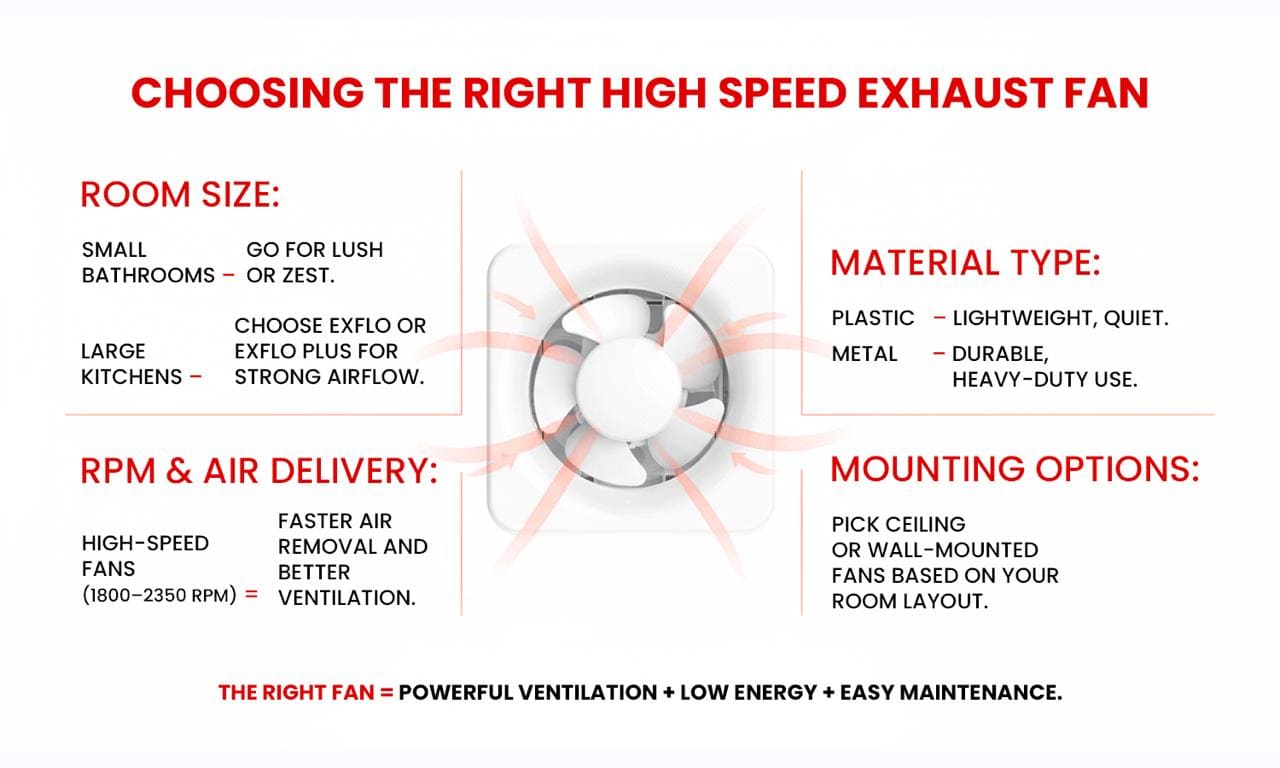
For domestic kitchens where Indian cooking involves deep frying or heavy grilling, standard low-speed fans fall short. Modern kitchens require a minimum motor rotation speed of 1800 to 2350 exhaust fan rpm to effectively evacuate thick smoke and intense heat.
If your cooking space is compact or heavily enclosed without large windows, choosing a high-speed metal or heavy-duty unit operating at 2300+ speed ensures immediate smoke expulsion. To discover specific models designed for heavy culinary demands, explore our detailed Best Exhaust Fan for Kitchen guide.
High Speed Requirements for Bathroom Ventilation
Bathrooms present a completely different set of air quality challenges compared to kitchens. Instead of smoke and grease, bathroom ventilation deals primarily with the following:
-
High humidity
-
Water vapour
-
Persistent trapped odours
Excessive steam from hot showers settles on mirrors, tiles, and fixtures, creating an ideal breeding ground for mildew, fungus, and structural dampness.
Installing a reliable exhaust fan for bathroom spaces prevents moisture accumulation and keeps paint from peeling off walls. Since bathrooms are usually enclosed spaces with minimal natural air movement, air extraction must be swift and direct.
A high motor rotation speed ensures that steam is purged almost as fast as it is produced during a shower. Using a fan with an optimized exhaust fan rpm rating prevents foggy mirrors, reduces damp towels from smelling musty, and maintains a hygienic environment for your family every single day.
Recommended RPM Speed Range for Bathrooms
For standard residential bathrooms, an exhaust fan rpm range of 1500 to 2200 is generally recommended. Compact powder rooms or small toilets benefit greatly from compact fans operating near 2200 motor rotations, as their small blade diameters require higher velocity to move sufficient air volume.
For medium to larger bathrooms, a smooth rpm speed around 1350 to 1800 provides the perfect balance between swift steam extraction and peaceful, whisper-quiet operation. For a complete breakdown of bathroom ventilation options, check out our helpful Exhaust Fan for Bathroom guide.
Kitchen vs. Bathroom: RPM Speed & Airflow at a Glance
Choosing between kitchen and bathroom units becomes easier when you compare their operational requirements side by side. Kitchens prioritize raw speed and heat removal, whereas bathrooms focus on consistent moisture extraction and quiet performance.
|
Parameter |
Kitchen Ventilation |
Bathroom Ventilation |
|
Recommended exhaust fan RPM |
1800 to 2350 RPM |
1350 to 2200 RPM |
|
Airflow Requirement (CMM / CFM) |
300 to 750 CMM (High Air Delivery) |
90 to 280 CMM (Moderate Air Delivery) |
|
Typical Sweep Size |
150 mm to 250 mm |
100 mm to 200 mm |
|
Noise Level |
Moderate to High (45 to 60 dB due to high air thrust and speed) |
Low to Moderate (35 to 50 dB for quiet, steam-free operation) |
|
Key Operational Focus |
Smoke, grease, and intense heat expulsion |
Moisture control, steam removal, and odour elimination |
|
Motor Rotation Metric |
Higher revolutions per minute for dense air |
Balanced revolutions per minute for lower noise |
Fybros High Speed Models Compared by RPM
Fybros offers an extensive range of high-performance ventilation units engineered with robust motors and aerodynamic blades. If you are comparing models purely by motor rotation speed specs, here is how the top Fybros high-speed models stand out:
-
Fybros Exflo Plus: Delivering a massive 2350 exhaust fan rpm, the Exflo Plus stands as the ultimate heavy-duty performer. Operating with a 40W motor and delivering up to 350 CMM airflow, it is built specifically for heavy cooking setups as a powerful exhaust fan for kitchen spaces.
-
Fybros Lush: Operating at an impressive 2200 exhaust fan rpm, the Lush is a sleek axial fan running on just 18W power. Its compact design and ultra-high motor speed make it an exceptional choice as an exhaust fan for bathroom setups requiring fast moisture removal.
-
Fybros Zest: Running at 1800 exhaust fan rpm with a 22W energy footprint, the Zest delivers 250 CMH airflow with a 150 mm sweep. It offers an ideal middle-ground performance for mid-sized kitchens and home bathrooms alike.
-
Fybros Ventflo: Operating at a steady 1350 exhaust fan rpm, the Ventflo provides normal speed ventilation with a 35W motor delivering 280 CMM airflow. It features dust-protection louvers and quiet operation, making it ideal for daily residential use.
Conclusion
Selecting the right ventilation system ultimately comes down to matching motor performance with the functional needs of your room. Relying solely on blade dimensions without checking motor rotation speed can leave you with an underperforming unit that struggles to keep your home fresh. High motor speeds provide the suction velocity needed to remove smoke, heat, steam, and dampness before they cause long-term damage to your home interiors.
By evaluating the exhaust fan rpm specifications across the Fybros lineup, you can easily find a model that delivers optimum airflow, low power consumption, and long-lasting reliability. Investing in a quality ventilation unit ensures a healthier indoor atmosphere while offering great value relative to overall exhaust fan price points in the market.
FAQs
1. How Many RPM Is Considered "High Speed" for an Exhaust Fan?
In residential ventilation, any exhaust fan operating at or above 1800 RPM is considered high speed.
2. Do Bathrooms Need the Same RPM as Kitchens?
Not necessarily, as kitchens require higher RPMs (1800 to 2350+) to clear dense smoke and oil vapors, whereas bathrooms usually need moderate RPMs (1350 to 1800) primarily to manage steam and moisture.
3. Does Higher RPM Mean More Noise?
While higher speeds naturally produce more air turbulence, modern designs with aerodynamic blades and vibration-absorbing gaskets keep operating noise relatively low.
4. Which Fybros High-Speed Fan Has the Highest RPM?
The Fybros Exflo Plus has the highest speed in the lineup, operating at 2350 RPM.