
 Fans
Fans
 Switches & Accessories
 Led Lighting
 Wires & Cables
 Switchgear
How Does a High Speed Table Fan Work? Complete Working Explained
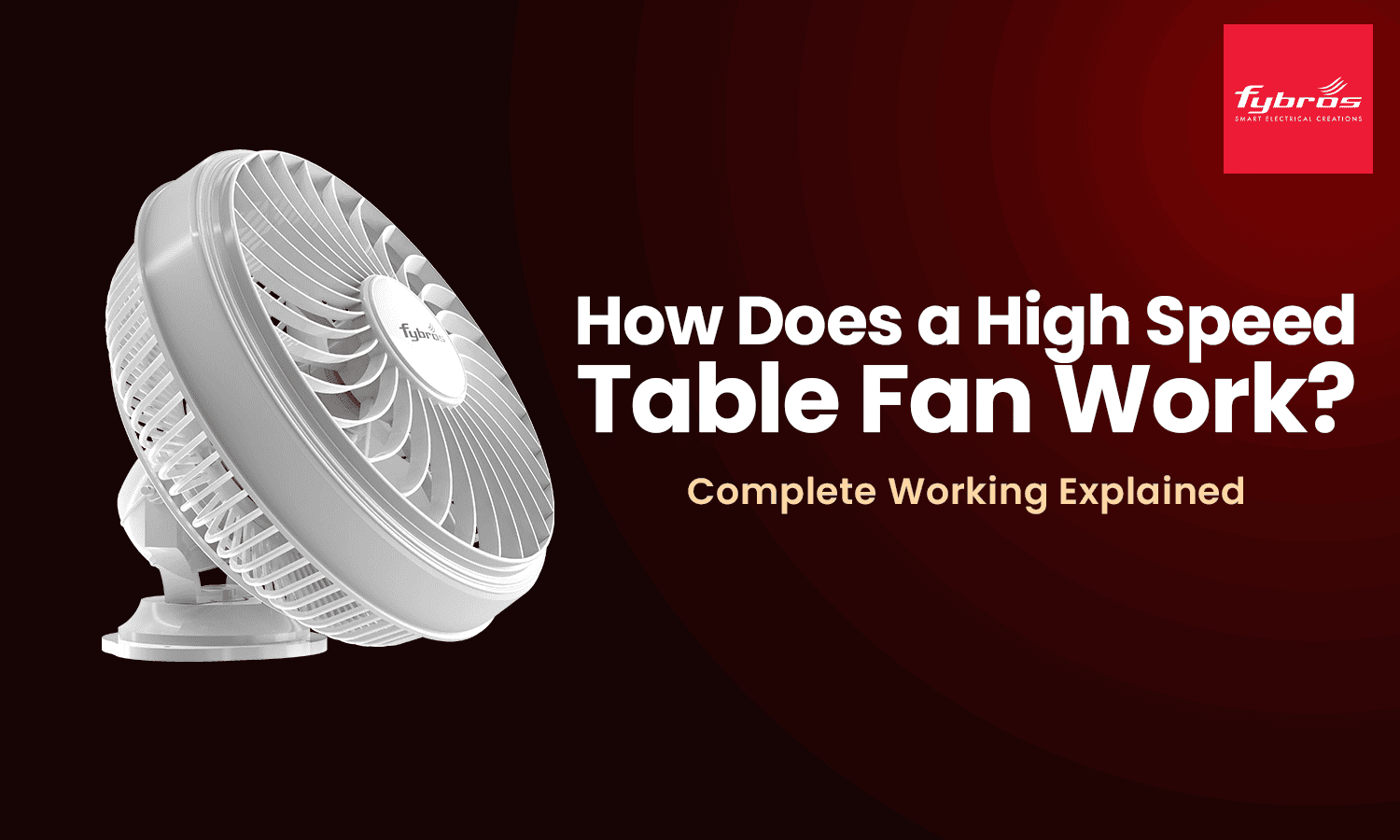
What is a High Speed Table Fan?
A high-speed table fan is a portable cooling device designed for intense, localized airflow. While a standard fan might rotate at around 1300 RPM, a "high-speed" variant like the Fybros Gush Table Fan can reach up to 2200 RPM. This higher rotation speed allows the fan to deliver a cooling breeze even in stuffy environments like an Indian kitchen or a small office cabin.
Working Principle of a High-Speed Table Fan
The working of a table fan is a perfect example of electromagnetism in action. Here is the step-by-step process:
-
Power Intake: When you plug in the fan, AC flows into the stator (the stationary part of the motor).
-
Magnetic Field Creation: The current passes through copper windings, creating a rotating magnetic field.
-
Torque Generation: This magnetic field induces a current in the rotor (the rotating part), causing it to spin. This is why the motor is called an "induction motor."
-
Air Displacement: As the rotor spins, it turns the fan blades. The aerodynamic blades are angled to pull air from the back and push it forward at high velocity.
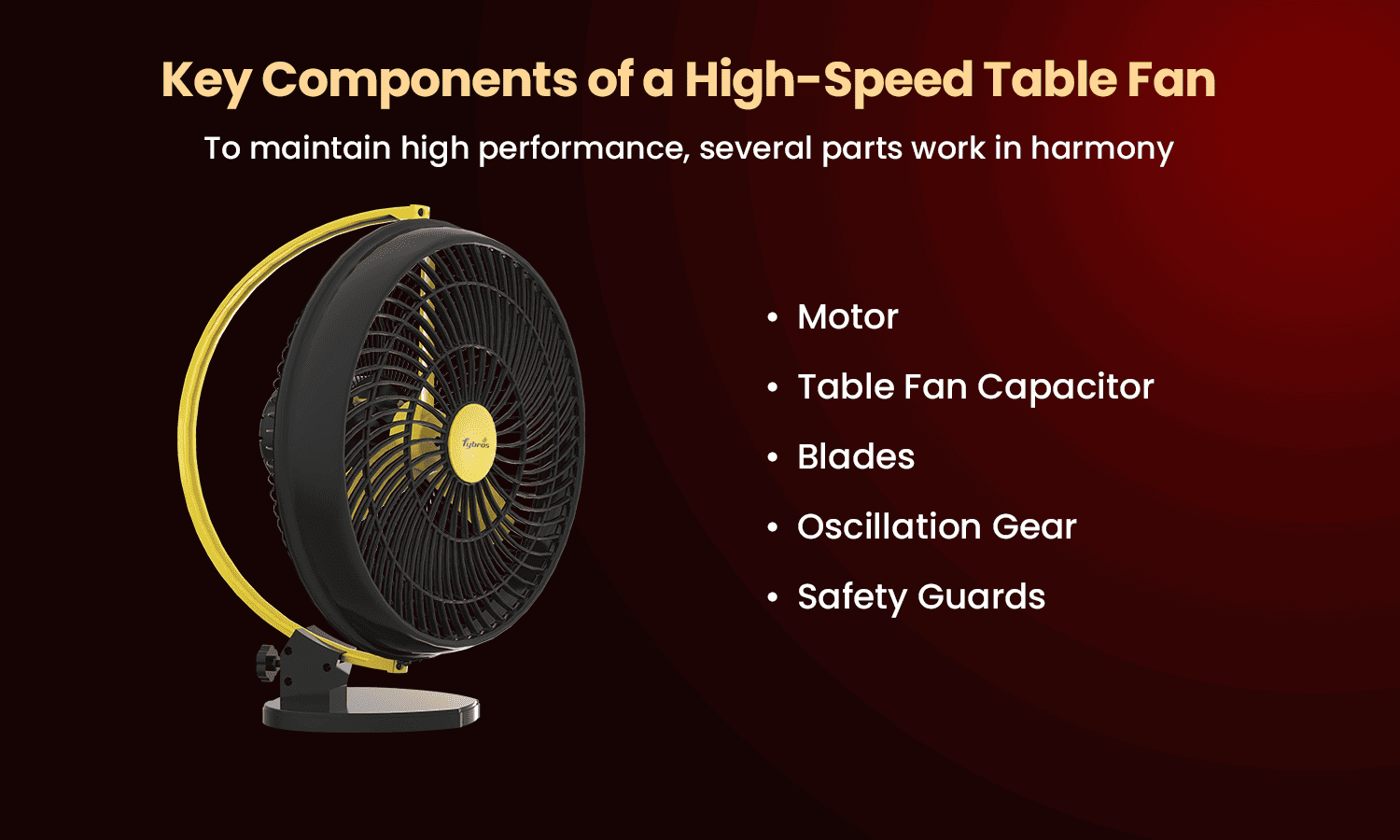
Key Components of a High-Speed Table Fan
To maintain high performance, several parts work in harmony:
-
Motor: Usually a high-torque induction motor with 100% copper winding for durability.
-
Table Fan Capacitor: This small component is vital for starting the motor and maintaining the correct fan speed control.
-
Blades: High-speed fans often use 3-blade designs made of high-quality resin or aluminum to reduce weight and increase "thrust."
-
Oscillation Gear: A synchronous motor or a mechanical gearbox that allows the fan to swing left and right (typically 90°).
-
Safety Guards: Rust-resistant, powder-coated grills that protect users from the fast-moving blades.
Type of Motors Used in a High-Speed Table Fan
-
Induction Motor: The industry standard. Found in models like the Vayu Table Fan, these are valued for being robust and cost-effective.
-
BLDC Table Fan Motor: The modern choice. These are brushless, meaning they produce less friction, less noise, and consume significantly less power while maintaining high speeds.
-
Shaded Pole Motor: Often used in very small table fan models; simple but less efficient for high-speed requirements.
Common Problems & Maintenance Tips
Even the best high-speed table fan in India needs a little care to stay efficient.
-
Problem: The fan is Slow. This is often due to a weak table fan capacitor or dust buildup in the motor vents.
-
Problem: Noisy Operation. Usually caused by dry bearings. Applying a few drops of lubricating oil to the motor shaft can fix this.
-
Maintenance: Unplug and clean the blades once a month. Dust adds weight to the blades, which forces the high-speed fan motor to work harder, eventually slowing it down.
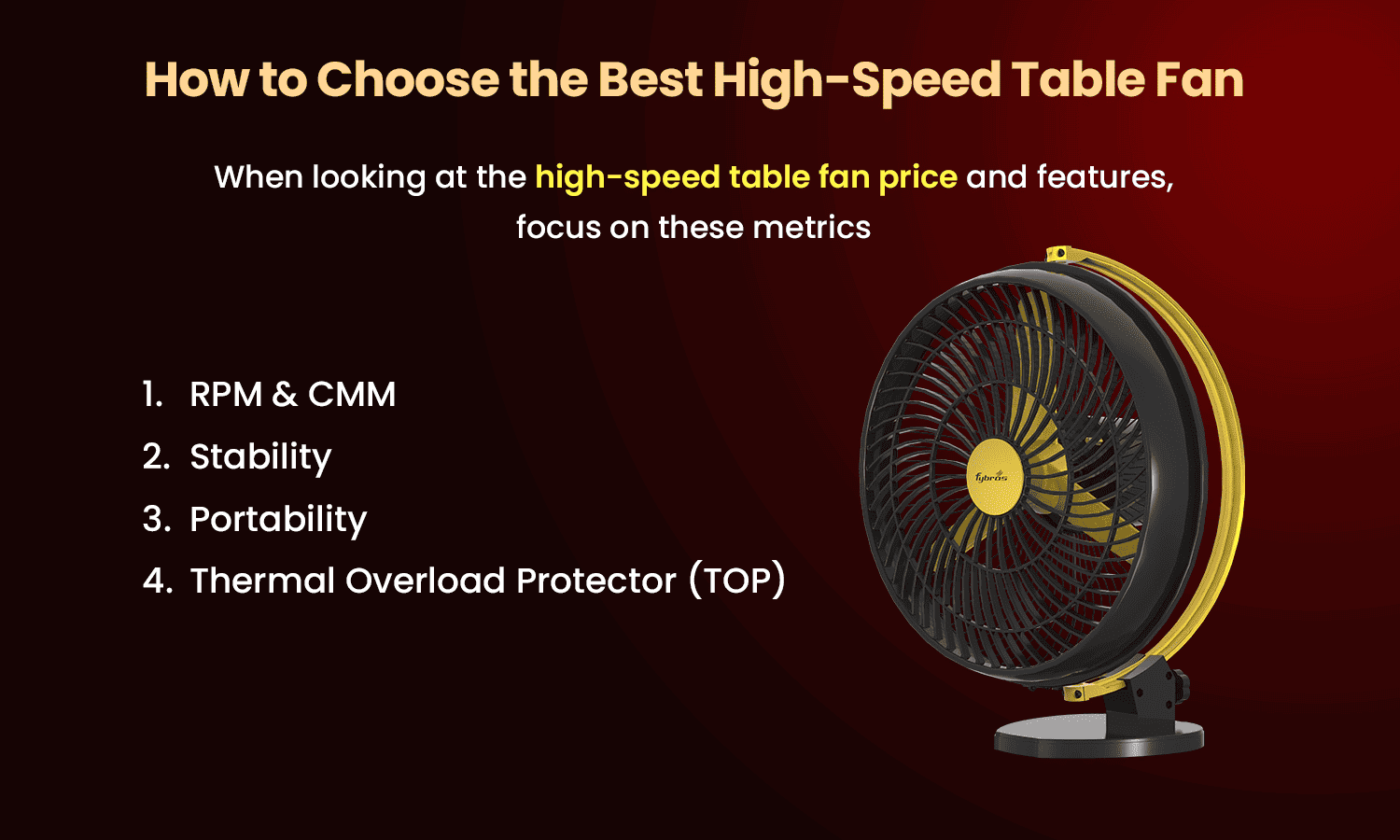
How to Choose the Best High-Speed Table Fan
When looking at the high-speed table fan price and features, focus on these metrics:
-
RPM & CMM: Don't just look at speed (RPM); check the Air Delivery (CMM). The Fybros Gush delivers 90 CMM, which is excellent for a 400mm sweep.
-
Stability: A high-speed small table fan must have a sturdy base to prevent it from "walking" or vibrating on the desk at top speed.
-
Portability: Look for a portable table fan with a built-in handle and a long power cord for easy movement.
-
Thermal Overload Protector (TOP): Ensure the fan has a TOP to automatically shut off the motor if it overheats, preventing fires.
Key Takeaways
-
The Core Mechanism: Table fans convert electrical energy into mechanical energy using an induction motor.
-
Speed Secret: A high-speed table fan relies on high RPM (Rotations Per Minute) and aerodynamically designed blades to move large volumes of air.
-
Induction vs. BLDC: While most high-speed table fans use induction motors for reliability, newer BLDC models offer higher efficiency and quieter operation.
-
Targeted Cooling: Unlike ceiling fans, table fans provide focused, directional airflow, making them perfect for kitchens and study desks.
FAQs
1. How to check the capacitor of a table fan?
If your fan hums but doesn't spin, or requires a manual "push" to start, the capacitor is likely dead. A technician can test it using a multimeter to see if it holds a charge.
2. Which company is best for table fans?
Fybros is a leading choice in 2026, offering specialized high-speed models like the Gush (2200 RPM) and Vayu (1330 RPM) that balance power with a 2-year warranty.
3. Why is my table fan slow?
The most common reasons are a faulty capacitor, jammed motor bearings due to a lack of lubrication, or heavy dust accumulation on the blades.
4. What is the RPM of a high-speed table fan?
A standard table fan runs at 1300–1400 RPM. A high-speed table fan typically operates between 2100 and 2400 RPM.