
 Fans
Fans
 Switches & Accessories
 Led Lighting
 Wires & Cables
 Switchgear
The Simple Guide to Choosing an LED Downlight
Overview
An LED downlight is a compact fitting recessed into the ceiling so only a neat ring of light shows. It suits living rooms, kitchens, corridors and shops, and comes in many wattages, shapes and colours. Choosing one means matching the cut-out size, the wattage and the beam to the space.
Few fittings change the feel of a ceiling as much as a downlight. Instead of one bright light hanging in the middle, you get several small, clean pools of light set flush into the ceiling. The result looks calm and premium, which is why hotels, showrooms and modern homes lean on it so heavily. A well-placed LED downlight gives you both soft background light and sharp task light, depending on where you point it and how many you use.
The choices are practical rather than complicated. You need to match the hole it sits in, pick a wattage for the job, and choose a colour and a beam. This page walks through each one, and shows where a panel or a surface fitting might suit you better instead.
What a Downlight Is and Where It Fits
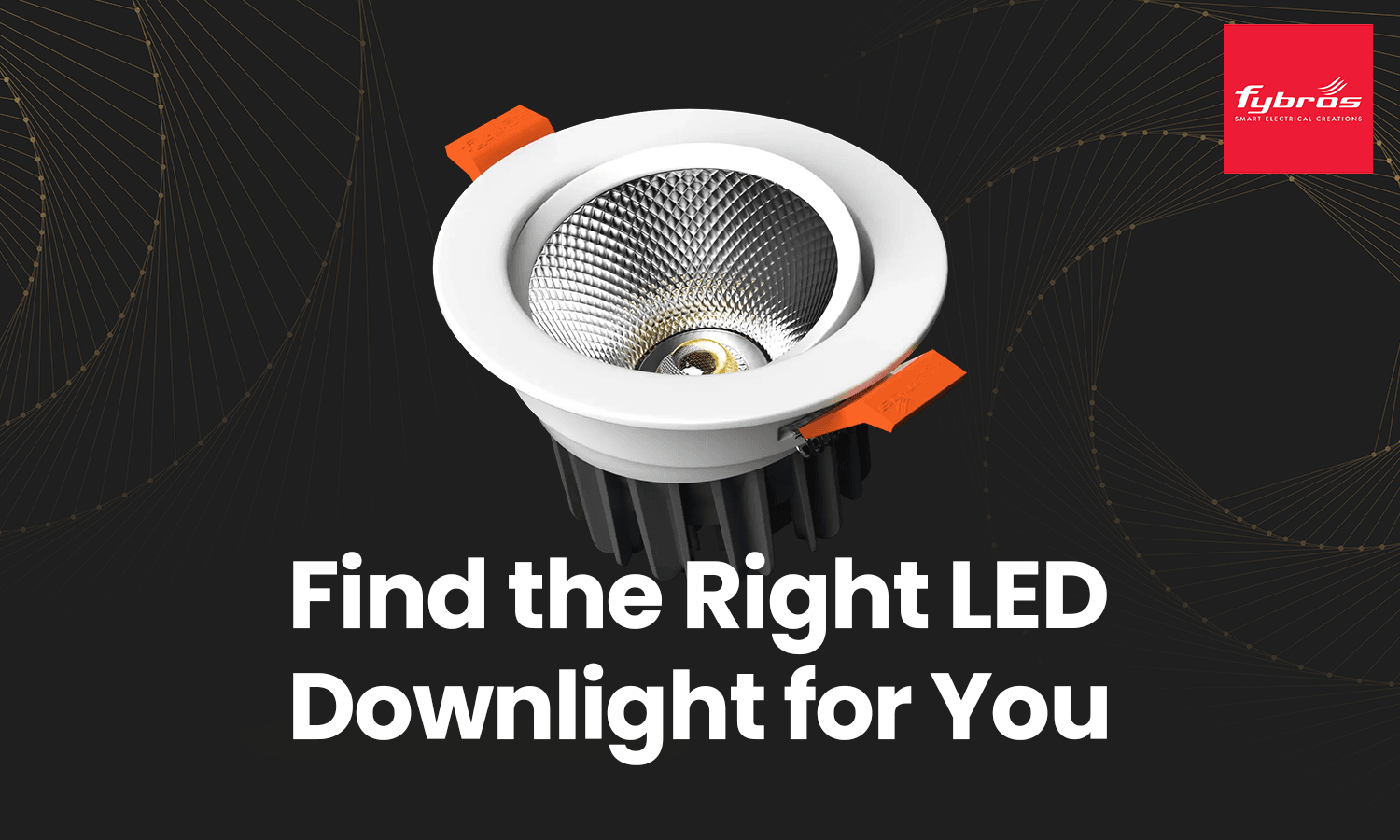
A downlight sits inside the ceiling and throws its light downward through a small opening. Because the body hides above the ceiling, only a slim ring shows, which keeps the look clean. A led recessed downlight is the most common type, dropped into a cut-out in a false ceiling. Where there is no gap above the ceiling, a surface mounted downlight does the same job while sitting on the surface. Both light living rooms, kitchens, passages, offices and retail counters well.

COB and Panel-Style Downlights
Downlights come in two broad styles. A COB downlight uses a single bright chip behind a reflector, which gives a crisp, focused beam that makes colours pop, so it suits showrooms, feature areas and premium homes. A slimmer panel-style led downlight for ceiling use gives a softer, wider spread for everyday rooms. Fybros makes both, from the COB OPAL and PACE ranges to the slim AIR, MAC and ROSO downlights, so you can pick sharp accent light or gentle general light as the room needs.
Size, Wattage and Beam
Three numbers matter most. The cut-out size decides the hole you need, so always check it against your ceiling. The wattage decides brightness, and a small downlight led 15w rating suits general rooms while lower 3W to 7W units work as accents and higher 25W to 35W units light larger or taller spaces. The beam angle decides spread, with a narrow beam for highlighting and a wide beam for filling a room. Fybros downlights run from 3W right up to 35W, so there is an LED downlight for every spot.
Colour and Dual-Colour Options
Every LED downlight carries a colour rating, and it sets the mood of the room. Warm white near 3000K feels welcoming in a living room, neutral near 4000K is balanced, and cool white near 6000K keeps a kitchen or study sharp. Some Fybros ranges add a dual-colour or 3-in-1 option, so a single led cob downlight or slim unit can shift its tone through the day. A bright cob downlight in the right colour makes a display or a dining table look its best, and even a surface mounted downlight can switch colour the same way.

Downlight or Panel
People often ask about the difference between a ceiling panel and a downlight, since both recess into the ceiling. The simple answer is spread. A panel floods a whole room with soft, even light, while a downlight gives focused pools you can place exactly where you want them. Seeing them together makes the choice clear.
| Point | LED Downlight | LED Panel |
|---|---|---|
| Light pattern | Focused pool of light | Wide, even wash |
| Best use | Accents, task spots, layered lighting | General light for a whole room |
| Look | Small ring, very discreet | Flat lit surface, flush |
| Recess needed | Small round cut-out | Larger cut-out |
| Fybros range | AIR, MAC, ROSO, OPAL, PACE | FARO, VIO, CUBE, LUME |
In practice most rooms use both. Panels give the base light and downlights add accents over a sofa, a counter or a piece of art. If you want the fuller picture on flat ceiling lighting, our guide to slim panel lights sits alongside this one, a surface fitting helps where the ceiling cannot be cut, and the broader view of ceiling lighting ties the choices together.
Installation and Who Should Fit It
A downlight needs a hole cut to the right size, a driver connected, and the fitting clipped neatly into place. In a ready false ceiling with the cut-outs already marked, this is quick work. On a fresh ceiling or a concrete slab it takes more planning. A common question is who should fit it, and for anything wired to the mains an electrician is the safe answer. Cutting the opening cleanly and making the connection properly is what keeps a led downlight safe and long-lasting, so it is not the place to cut corners.
The Fybros Downlight Range
Fybros is a genuine led downlight manufacturer with a deep range under one name. The AIR, UNO, MAC, ORA and ROSO ranges cover slim junction downlights from 3W to 15W, the CELIA range adds a dual-colour look, and the COB OPAL, F-SPIRIT and PACE ranges bring premium reflector downlights up to 35W. Colours run warm, neutral and cool, and some ranges offer a 3-in-1 switch. That spread means you can light a whole home or a full project with matching fittings, which is hard to do when buying loose units from different brands.
FAQs
1. What is the difference between a ceiling light and a downlight?
A ceiling light usually sits on the surface and lights the whole room broadly, while an LED downlight recesses into the ceiling and gives a neat, focused pool of light. Downlights look more discreet and let you place light exactly where you need it, which is why they suit layered, modern schemes better than one central fitting.
2. Can I install an LED downlight myself?
You can fit one into a ready cut-out in a false ceiling, but the mains connection should be left to an electrician. A wrong-sized hole, a loose driver or a poor joint can shorten the life of a led recessed downlight or create a hazard, so the safe route is to do the placing yourself and let a professional handle the wiring.
3. How much does an LED downlight cost?
The led downlight price depends on the type and wattage. Slim junction downlights sit at the affordable end, while COB reflector models cost more because of the brighter chip and better optics. As with most lighting, buying the right type for the room gives better long-term value than picking the cheapest unit on the shelf.
Key Takeaways
-
An LED downlight recesses into the ceiling and gives neat, focused pools of light, which looks clean and premium.
-
Choose a COB model for a sharp accent beam and a slim panel-style unit for softer general light.
-
Match the cut-out size, the wattage and the beam to the space, with roughly 15W for general rooms.
-
Use downlights and panels together, panels for base light and downlights for accents.
-
Fybros offers slim, COB and dual-colour downlights from 3W to 35W in warm, neutral and cool tones.
Upgrading a ceiling or planning a new one? See the full Fybros downlight range, from slim junction models to bright COB reflectors, and choose the LED downlight that fits your ceiling and your room. Visit fybros.com or ask your nearest Fybros dealer for the right size and beam.