
 Fans
Fans
 Switches & Accessories
 Led Lighting
 Wires & Cables
 Switchgear
Rechargeable Fan Price & Buyer’s Guide: Comparing Battery Costs, Sizes, and Features

Introduction
Rechargeable fan price is a key consideration when shopping for a portable cooling device to handle power outages, warm summer afternoons, and flexible personal ventilation in modern households. Whether you are working at a study desk, preparing meals in a hot kitchen, or relaxing outdoors, a battery-powered cooling device offers immediate relief without requiring a continuous direct power supply. When shopping for an ideal unit, evaluating the overall rechargeable fan price against physical sweep size, battery capacity, motor efficiency, and overall build quality helps you secure maximum value for your investment.
Fybros designs versatile ventilation solutions engineered for efficient cooling and long-lasting performance. Understanding how different technical specifications influence the overall rechargeable fan price allows buyers to pick a unit that matches both their everyday cooling demands and their planned household budget.
Rechargeable Fan Price Breakdown by Fan Type
Not all portable fans serve the same functional purpose. The market offers a wide variety of configurations, ranging from mini portable fans to full-sized table models equipped with oscillating bases. Because motor capacity, blade sweep size, and structural material vary significantly across these design styles, the overall rechargeable fan price changes according to the fan type you choose..
Small personal models engineered for close-range airflow use lightweight plastic housing and compact motors, keeping manufacturing costs lower. In contrast, larger table models designed to cool entire rooms require heavier copper-wound motors, multi-speed circuitry, and high-density outer grills, which naturally elevates their retail cost.
Rechargeable Table Fan Price & Specifications
A table fan represents a powerful middle ground for home cooling, delivering strong directional air thrust for study tables, bedroom nightstands, or kitchen counters. Standard table variants typically feature sweep sizes between 200 mm and 300 mm, multi-speed controls, tilt adjustment, and wide oscillation to distribute air evenly across a personal seating area.
When analyzing the rechargeable table fan price, consumers usually find these mid-sized models ranging between 1800 INR and 3500 INR, depending on motor wattage and housing durability. Selecting a well-constructed table model ensures reliable motor operation and steady airflow during extended power cuts, making the rechargeable fan price worthwhile for daily household convenience.
Portable Electric Fan Price & Compact Models
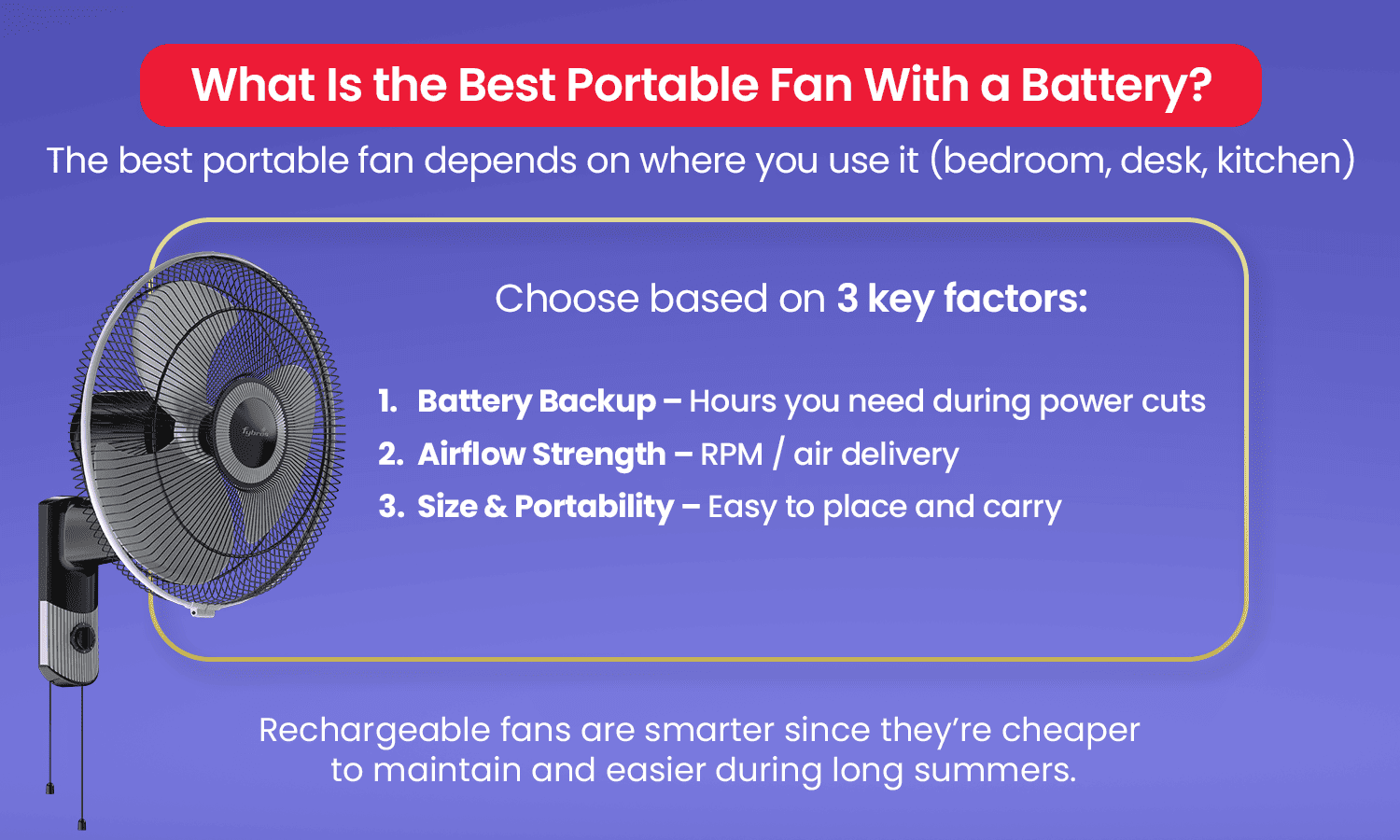
For users who prioritize mobility over wide room coverage, mini handheld units and foldable desk models offer unmatched convenience. These ultra-compact units fit effortlessly into travel backpacks, office bags, or small bedside drawers, providing focused cooling right where you need it most.
When comparing options, the overall portable electric fan price for basic models generally falls between 800 INR and 1500 INR. However, premium foldable designs with tilt adjustment, silent resin blades, and dual power input features command a slightly higher portable rechargeable fan price, often ranging from 1500 INR to 2500 INR. Checking these feature sets helps you secure a compact unit that balances convenience, motor durability, and affordable pricing.
Rechargeable Battery Fan Price vs. Battery Capacity (mAh)
The internal battery pack is the single most expensive component inside any cordless fan. Battery storage capacity is measured in milliampere-hours (mAh), which directly dictates how many hours the unit can run on a single charge. Consequently, the rechargeable battery fan price scales upward as battery capacity increases.
A higher mAh rating allows the motor to maintain continuous high-speed rotation without draining power rapidly. When assessing any rechargeable fan price, comparing the underlying battery chemistry, such as standard lead-acid versus modern lithium-ion cells, ensures you understand why two visually similar fans carry noticeably different price tags.
Low Capacity (2000 mAh – 3000 mAh) Price Range
Low-capacity battery units are ideal for short power interruptions, personal desk use, or brief outdoor errands. Equipped with battery banks ranging from 2000 mAh to 3000 mAh, these fans typically provide 2 to 4 hours of continuous operation on normal speed settings.
Because smaller battery packs keep production costs minimal, the rechargeable fan price for units in this category usually ranges from 1000 INR to 1800 INR. They offer an economical entry point for students or professionals needing quick personal relief without investing in heavy-duty battery backups.
High Capacity (4000 mAh – 10000 mAh) Price Range
High-capacity fans are engineered for extended usage during prolonged power outages, overnight sleeping, or camping trips. Packing substantial battery reservoirs between 4000 mAh and 10000 mAh, these units can run continuously for 6 to 12 hours depending on the selected speed mode.
The inclusion of large lithium-ion battery packs pushes the rechargeable fan price for high-capacity models into the 2500 INR to 5000 INR range. While the upfront investment is higher, the extended run time and reliable backup performance provide exceptional value for regions prone to frequent electrical cuts.
BLDC Motor Technology Impact on Pricing
Brushless Direct Current (BLDC) motor technology has revolutionized the portable appliance industry. Unlike traditional induction motors that waste energy through friction and heat loss, BLDC motors operate with permanent magnets, consuming up to 50 percent less power from the battery pack.
Integrating a BLDC motor increases the initial rechargeable fan price by roughly 20 to 30 percent compared to standard motor models. However, because BLDC motors draw significantly less current, they dramatically extend battery backup hours on a single charge and lengthen the overall lifespan of the internal battery, making them a cost-effective long-term choice.
Portable Fan Battery Price & Replacement Costs
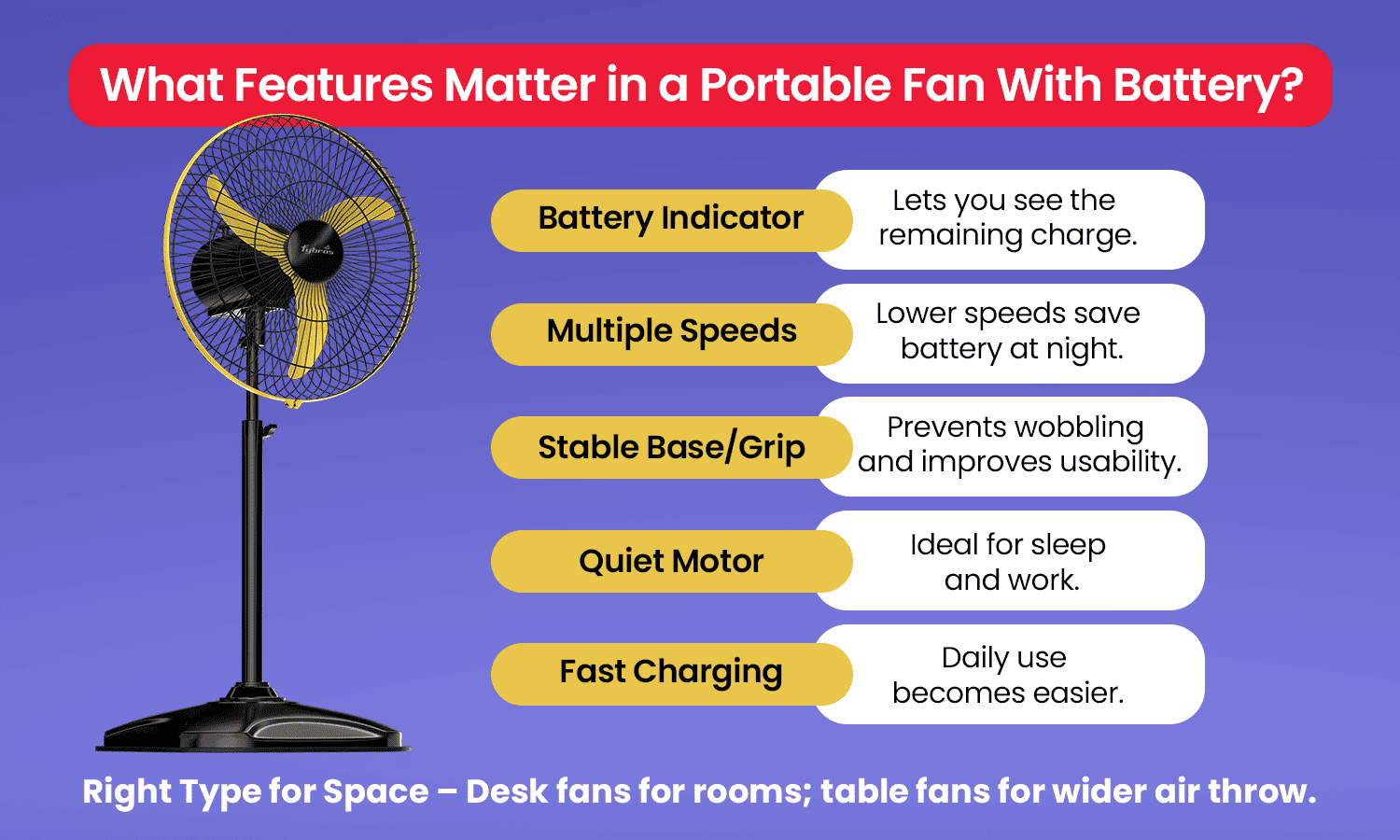
Every rechargeable appliance experiences gradual battery degradation over years of repeated charge cycles. Understanding future maintenance requirements helps you evaluate the true long-term cost of owning a cordless fan.
Factoring in the anticipated rechargeable fan battery price upfront ensures that you do not face unexpected expenses when the internal cell eventually loses its ability to hold a full charge after several seasons of regular use.
Cost of Replacement Batteries vs. New Fan Purchase
When a fan battery begins to fail, homeowners must decide whether to replace the internal battery cell or purchase an entirely new fan unit. Replacement lithium-ion battery packs generally cost between 400 INR and 900 INR depending on voltage and mAh capacity.
When evaluating the standalone rechargeable fan battery price against the full rechargeable fan price of a brand-new unit, replacing the battery is almost always the more economical path if the fan motor, blades, and speed controller remain in good working condition. Choosing fans with easily accessible battery compartments simplifies this replacement process considerably.
Battery Lifespan, Care, and Long-Term Value
To maximize the working lifespan of your portable fan and avoid premature replacement costs, proper battery maintenance is essential. Simple user habits can significantly slow down battery degradation and keep your unit performing like new for years.
Follow these key maintenance tips to protect your investment:
-
Avoid complete discharge: Recharge the battery before it drains completely down to zero percent, as deep discharge cycles shorten lithium-ion cell lifespan.
-
Prevent overcharging: Disconnect the charger once the indicator light signals a full charge to prevent thermal stress on the battery pack.
-
Off-season storage care: If storing the fan during winter months, charge the battery to roughly 50 percent capacity and store the unit in a cool, dry room.
Taking good care of the internal battery ensures your unit delivers optimal backup time season after season, maximizing overall product value relative to the original rechargeable fan price paid at purchase.
FAQs
1. What determines the total rechargeable fan price?
The overall cost depends on battery capacity (mAh), motor type (BLDC vs. induction), fan sweep size, and additional features like oscillation or USB charging ports.
2. Is a BLDC motor model worth the higher upfront price?
Yes, because a BLDC motor uses up to 50% less energy, which significantly extends battery runtime per charge and saves money on long-term replacement costs.
3. How much does a replacement battery cost compared to buying a new fan?
A replacement battery usually costs between ₹400 and ₹900, making it a budget-friendly option compared to buying an entirely new fan unit.
4. What is the typical price range for a high-capacity rechargeable table fan?
High-capacity fan models (4000 mAh to 10000 mAh) generally range from ₹2,500 to ₹5,000 depending on build quality and backup duration.