
 Fans
Fans
 Switches & Accessories
 Led Lighting
 Wires & Cables
 Switchgear
Understanding Switchgear Components in Every Electrical Panel
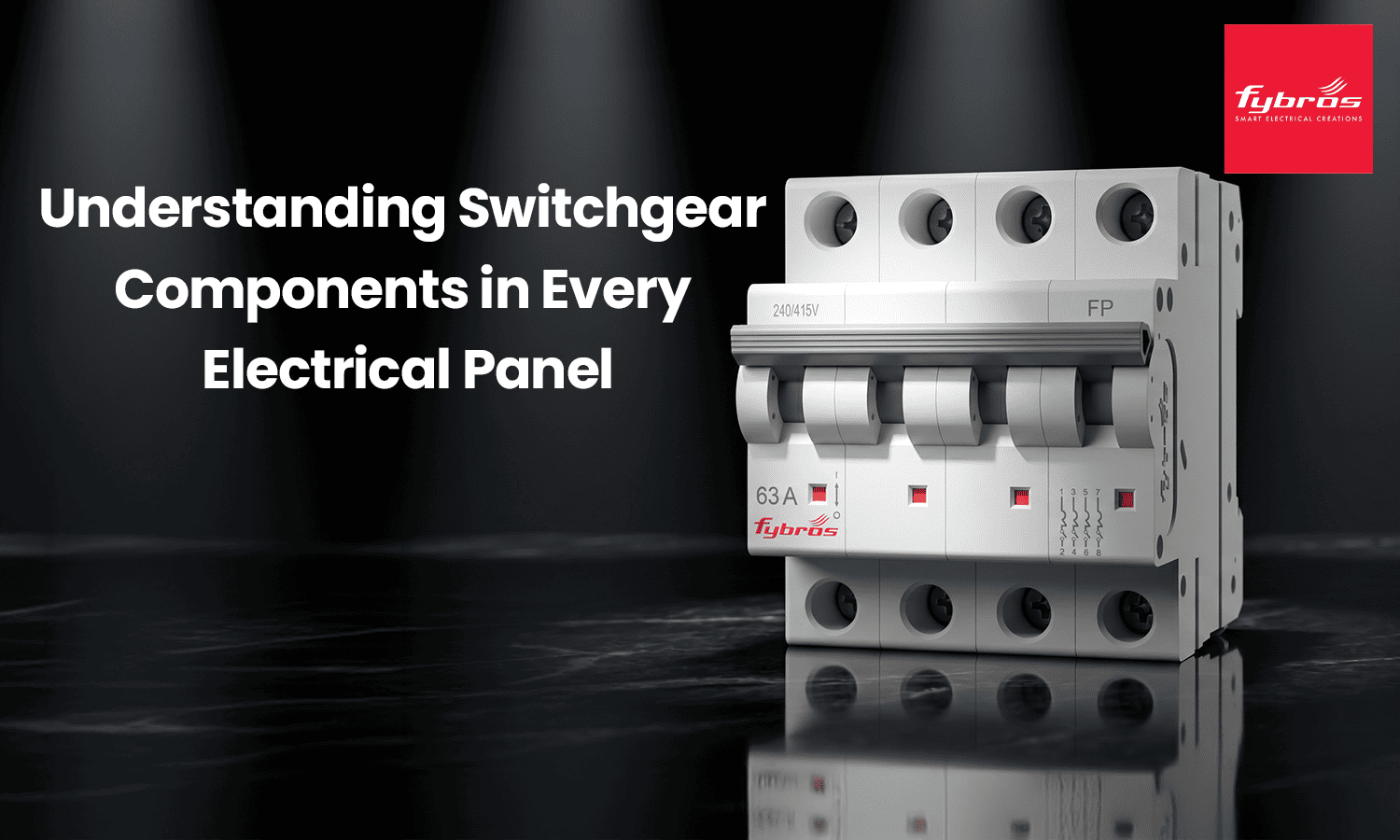
Switchgear can look intimidating from the outside with rows of breakers, colored cables, indicator lights, and metal cabinets. Underneath it all, every switchgear panel is built from a small set of recurring switchgear components. Once you understand what each one does, the whole panel becomes easier to understand.
How Circuit Breakers Protect Electrical Systems
Circuit breakers are among the most visible electrical switchgear components. They sense fault currents and break the circuit automatically. Once the fault is cleared, they can be reset manually.
In low-voltage switchgear, the dominant breaker type is the miniature circuit breaker, or MCB. These are fundamental components of LT switchgear. For higher ratings, molded case circuit breakers, or MCCBs, are used. At the top of the LT range, air circuit breakers or ACBs handle thousands of amps.
Moving up the power scale, medium voltage switchgear components include vacuum circuit breakers (VCBs) and SF₆ circuit breakers. Both are designed to break much higher fault currents than LT breakers. In utility-scale applications, high voltage switchgear components are used to manage massive electrical loads across the grid.
Why Fuses Still Matter in Modern Systems
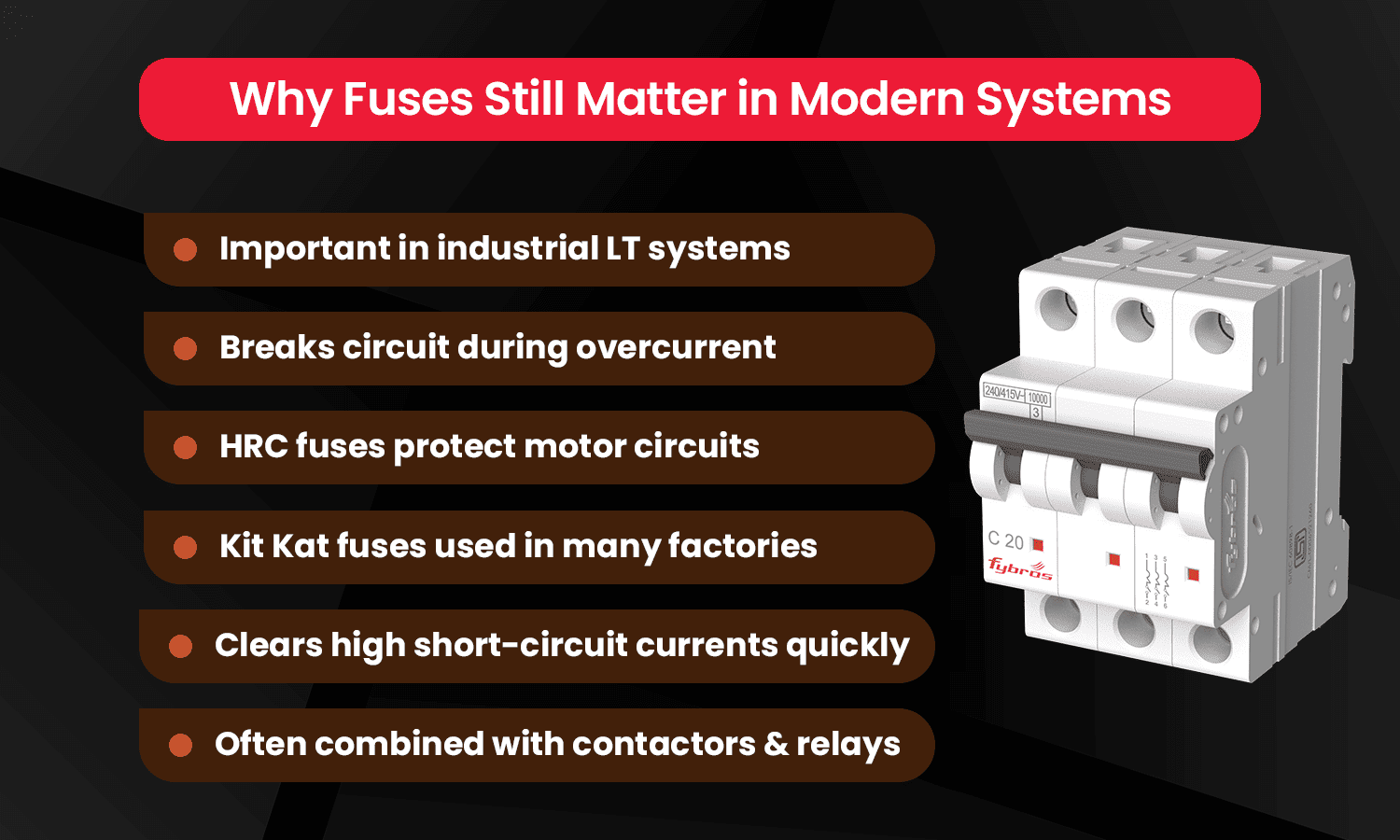
Fuses remain important switchgear components, especially in industrial LT systems. They use a sacrificial element that melts under overcurrent and breaks the circuit. HRC fuses are the standard for short-circuit protection in motor circuits. Rewireable Kit Kat fuses are still common in Indian factory installations.
Fuses have one major advantage over breakers because they clear extremely high short-circuit currents very quickly. That is why many modern switchgear panels combine fuses with contactors and overload relays for motor protection.
How Isolators Improve Electrical Safety
An isolator is a disconnecting switch designed to provide a visible off-load break in the circuit.
If you were to look at a switchgear components list, the isolator would be noted for its safety role rather than circuit interruption. Its purpose is to help technicians confirm that a circuit is fully de-energized before working on it.
In Indian installations, isolators range from small DP and TP units for residential and commercial use to large four-pole knife-type isolators used in industrial switchgear. Fybros builds isolators across both categories, including the ARMOR Isolator family.
Switches and Changeover Switches
On-load switches allow operators to open or close a circuit while it is carrying current. This makes them different from isolators. Changeover switches transfer load from one source to another. The most common application is utility-to-generator transfer in commercial and industrial sites.
Manual changeover switches are operated by hand. Automatic changeover switches such as ATS and AMF panels sense supply loss and transfer automatically. Both rely on the same core switchgear parts.
Protective Relays
If circuit breakers are the muscle of switchgear, protective relays are the brain. They measure current, voltage, and other parameters and instruct breakers when to operate.
Modern numerical relays deliver multiple components of switchgear protection, such as overcurrent and earth fault detection, within a single microprocessor-based unit.
These relays are one reason medium-voltage switchgear systems can be coordinated so precisely.
Current and Voltage Transformers
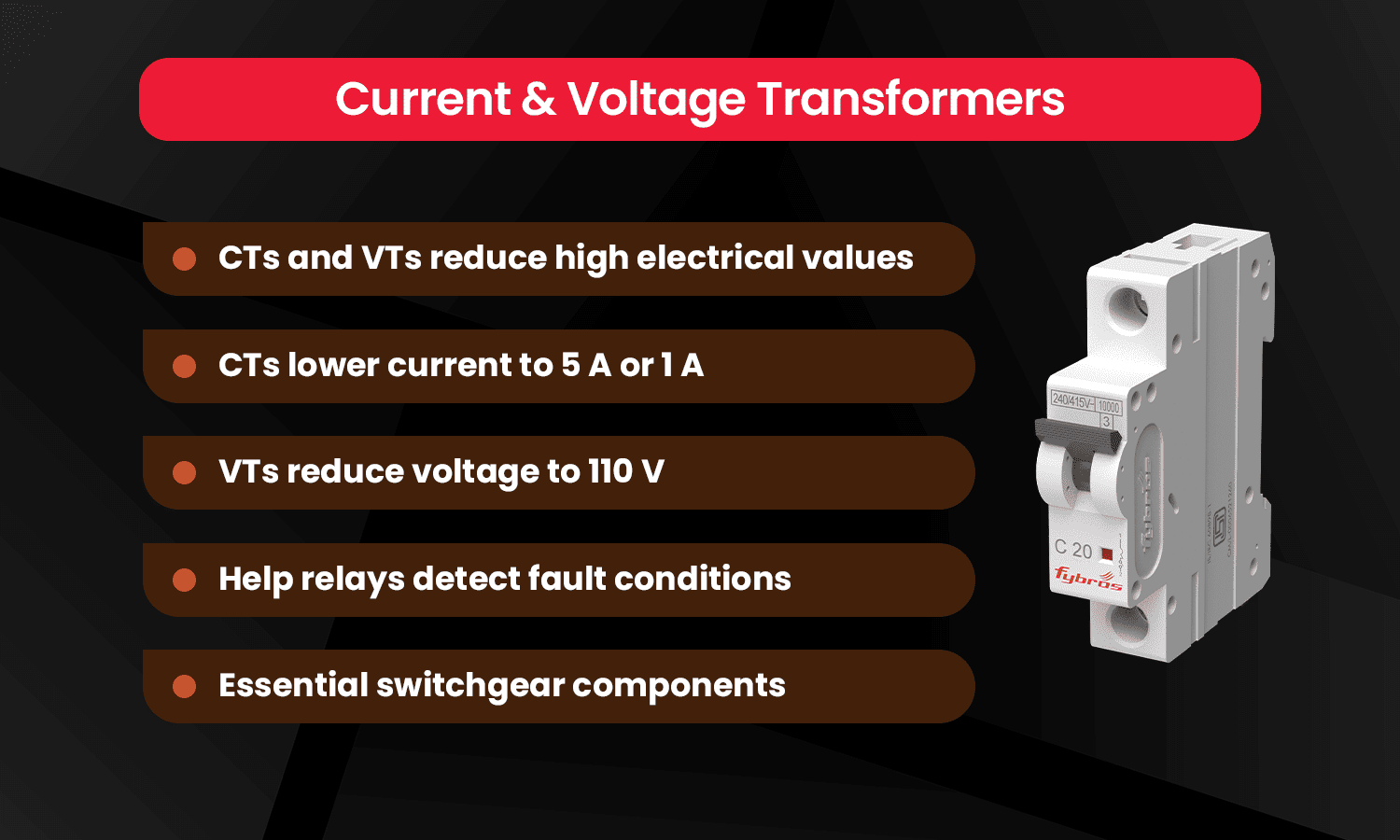
Protective relays cannot directly measure thousands of amps or kilovolts. Current transformers or CTs and voltage transformers or VTs reduce these signals to manageable values. A CT typically reduces current to 5 A or 1 A. A VT usually reduces voltage to 110 V.
These instrument transformers are foundational switchgear components. Their accuracy class determines how precisely relays can detect fault conditions.
Understanding the Role of Busbars
Busbars are copper or aluminum bars that carry current from the incoming breaker to outgoing feeders inside a switchgear panel. They are sized for the full load current and designed to withstand short-circuit forces. During a fault, magnetic forces on busbars can become extremely high.
Quality switchgear components use insulated, properly spaced, and well supported busbars rated for the panel fault level.
Enclosures and Mechanical Components
The metal enclosure transforms a collection of parts into a complete switchgear panel. It protects internal components of a switchgear system from dust, water, and tampering while also protecting people from accidental contact with live parts.
Ingress protection or IP ratings define how well the enclosure performs. IP54 is common for indoor industrial applications. IP65 is used for outdoor or washdown environments. Door interlocks, padlock provisions, and enclosure earthing all contribute to safe switchgear design.
How Fybros Designs Reliable Switchgear Components
Every Fybros switchgear product, from a single-pole MCB to a four-pole changeover switch, is built around these essential components of switchgear. The brand designs and tests its switchgear according to Indian standards, including IS IEC 60898 for MCBs, IS IEC 61008 for RCCBs, and IS IEC 60947 for isolators and switches.
The quality of switchgear components is what separates products that last for decades from systems that fail early. Fybros invests in metallurgy, terminal design, and arc-extinguishing chambers because these details determine real-world performance.
Putting It Together
Understanding the components of switchgear helps people move beyond treating a panel like a black box. It also makes conversations with electricians, contractors, and suppliers much easier.
Whether you are a homeowner reviewing a quotation or a project engineer specifying industrial switchgear, the same terminology applies, including breakers, fuses, isolators, relays, transformers, busbars, and enclosures.
Choose switchgear products that take every one of these components seriously. The Fybros range is built on that principle.
Common LT Failure Modes in Indian Installations
Field experience across Indian sites reveals several recurring failure modes in low-tension switchgear systems. Loose terminations are the most common. Under torqued lugs heat up under load, oxidise, and eventually fail. Thermal imaging inspections often reveal hot spots at these locations.
Another common issue is nuisance tripping caused by undersized devices or harmonic content from VFDs. Contact welding on contactors used for capacitive loads without surge protection is another recurring problem. RCCB false tripping caused by accumulated leakage from multiple appliances on a single circuit is also common. In many cases, redistributing loads across more circuits solves the issue.
Each of these failures has a practical engineering solution. Torque every termination correctly. Size devices with a sufficient margin. Add surge protection to capacitor banks. Limit each RCCB to circuits with combined leakage well below 10 mA during normal operation.
These simple practices help extend the life of switchgear components significantly.
FAQs
1. What are the main switchgear components in an electrical panel?
The primary switchgear components include circuit breakers, fuses, isolators, protective relays, current transformers (CTs), voltage transformers (VTs), busbars, changeover switches, and enclosures. Together, these devices help control, protect, and isolate electrical circuits safely.
2. What are the components of LT switchgear?
The most common components of LT switchgear include MCBs, MCCBs, ACBs, RCCBs, isolators, contactors, overload relays, busbars, and distribution boards. These devices are used in residential, commercial, and industrial low-voltage electrical systems.
3. What are the components of switchgear protection systems?
The protection-related components of switchgear include circuit breakers, fuses, RCCBs, protective relays, CTs, and VTs. These devices work together to detect abnormal conditions such as overloads, short circuits, and earth faults and disconnect the affected circuit safely.
4. What are the key medium voltage switchgear components?
Important medium voltage switchgear components include vacuum circuit breakers (VCBs), protective relays, CTs, VTs, busbars, disconnectors, earthing switches, and control panels. These components are designed to handle higher voltages and fault levels than LT systems.
5. Why are high voltage switchgear components important?
High voltage switchgear components are responsible for controlling and protecting power transmission and distribution networks. They safely interrupt large fault currents, isolate equipment for maintenance, and help maintain reliable operation across utility and industrial power systems.