
 Fans
Fans
 Switches & Accessories
 Led Lighting
 Wires & Cables
 Switchgear
Top 10 Tips to Maintain Your Modular Switch Box for a Longer Lifespan
Top 10 Tips to Maintain Your Modular Switch Box for a Longer Lifespan
A high-quality modular switch box is built to last 15–20 years. But like any electrical component, its lifespan depends significantly on how well it is maintained. Neglected switch boards accumulate dust, suffer loose terminal connections, and develop micro-arcing faults that degrade safety over time. These 10 maintenance tips, grounded in electrical safety best practice and Indian Standards, will keep your 12 module switch box performing at peak safety and reliability for its full designed lifespan.
Safety First: Always switch off the relevant MCB at the distribution board before performing any maintenance on a switch box. Never work on live terminals.
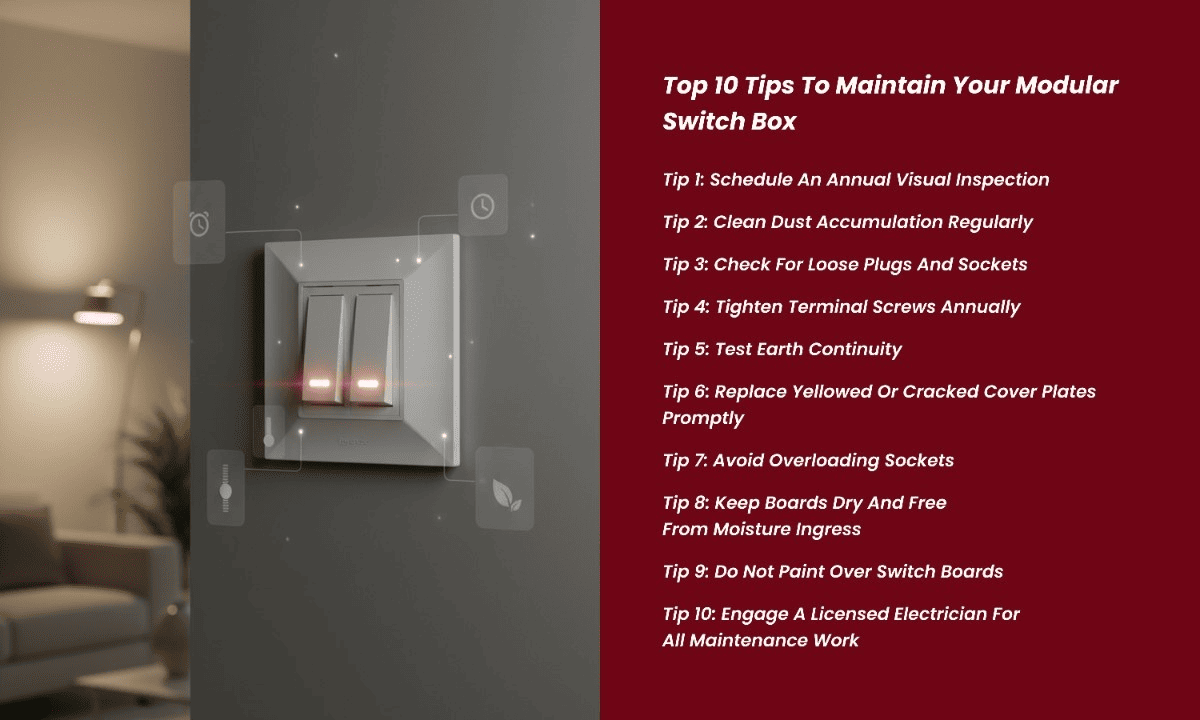
Tip 1: Schedule an Annual Visual Inspection
Once a year, examine your modular switch boards for visible signs of damage: discolouration (indicates heat stress), cracks in the frame or cover plate, and any modules that feel loose or wobbly in their slots. Early detection of minor issues prevents major failures.
Tip 2: Clean Dust Accumulation Regularly
Dust accumulation around switch modules, particularly in bedrooms, kitchens, and workshops, can speed up the wear of plastic components and may bridge terminal gaps, causing leakage current. Use a soft, dry microfibre cloth to clean cover plates monthly. For deep cleaning, switch off the MCB and use a soft dry brush. Never use water or liquid cleaners on switch boards.
Tip 3: Check for Loose Plugs and Sockets
If a plug feels loose when inserted into a modular socket, the socket's contact springs may have fatigued. A loose contact creates resistance heating, which is a primary cause of socket failure and fire hazard. A replacement modular socket can be fitted in minutes. Do not ignore a loose plug fit, as it signals a socket that needs replacement.
Tip 4: Tighten Terminal Screws Annually
Thermal cycling (heating and cooling from repeated current draw) can cause terminal screws to loosen over time. Loose terminals cause resistance heating and potential arcing. As part of your annual inspection, ask a licensed electrician to check and tighten all terminal connections in your switch boxes. This is particularly important in high-use boards (kitchen, living room).
Tip 5: Test Earth Continuity
The earthing circuit is your last line of defence against electrocution. Using a digital multimeter, test earth continuity at each socket annually: the resistance between the earth pin and the main earth point should be less than 0.5 Ω per IS:1293:2019. A higher reading indicates a broken earth path, which is a dangerous condition requiring immediate attention.
Tip 6: Replace Yellowed or Cracked Cover Plates Promptly
Polycarbonate cover plates on quality modular switch boards should retain their colour and finish for over a decade. If a cover plate has yellowed, cracked, or become brittle, the UV stabiliser and flame retardant additives may be depleted. Replace immediately, as a degraded plate offers reduced fire protection. Fybros replacement plates are available through authorized dealers nationwide.
Tip 7: Avoid Overloading Sockets
Always respect the ampere rating of each module. A 6A socket is rated for a maximum continuous current of 6 amperes, which is approximately 1,380 watts at 230V. Connecting a 2,000W appliance through an adaptor on a 6A socket causes sustained overload. Install a 16A modular socket wherever high-wattage appliances are used.
Tip 8: Keep Boards Dry and Free from Moisture Ingress
Moisture ingress is the most damaging environmental factor for switchboards in humid Indian climates. In bathrooms and kitchens, use only IP44-rated boards and modules. Check the back-box seal annually for gaps or cracks in the wall plaster around the box. Re-seal with appropriate filler if required to prevent moisture tracking.
Tip 9: Do Not Paint Over Switch Boards
During interior repainting, masking switch boards is essential. Paint, even water-based emulsions, can seep into module gaps, interfering with rocker mechanisms and leaving a film over socket shutters. More critically, paint can disrupt the earthing path at the metal frame. Always mask and protect your switchboards before any wall painting work.
Tip 10: Engage a Licensed Electrician for All Maintenance Work
While visual inspections are straightforward, all terminal work, module replacement, and earth continuity testing should be performed by a licensed electrician holding a valid Wireman's Certificate or higher. This ensures compliance with the Indian Electricity Rules and maintains your product warranty validity. Fybros's authorised dealer network can also help with product support and genuine replacement modules.
Maintenance Schedule at a Glance
|
Task |
Frequency |
Who Performs It |
|
Visual Inspection |
Annual |
Homeowner (licensed electrician for follow-up) |
|
Dust Cleaning |
Monthly |
Homeowner (MCB off) |
|
Socket Looseness Check |
Quarterly |
Homeowner — replace if loose |
|
Terminal Tightening |
Annual |
Licensed electrician |
|
Earth Continuity Test |
Annual |
Licensed electrician |
|
Cover Plate Inspection |
Annual |
Homeowner |
|
Moisture / Seal Check |
Pre-Monsoon |
Homeowner + civil contractor if re-sealing needed |
Related Read: Why Choose a 12 Module Switch Board? Features, Uses & Benefits — link to Fybros pillar blog