
 Fans
Fans
 Switches & Accessories
 Led Lighting
 Wires & Cables
 Switchgear
What Is Switchgear? A Clear Beginner's Guide for Indian Homes and Industries
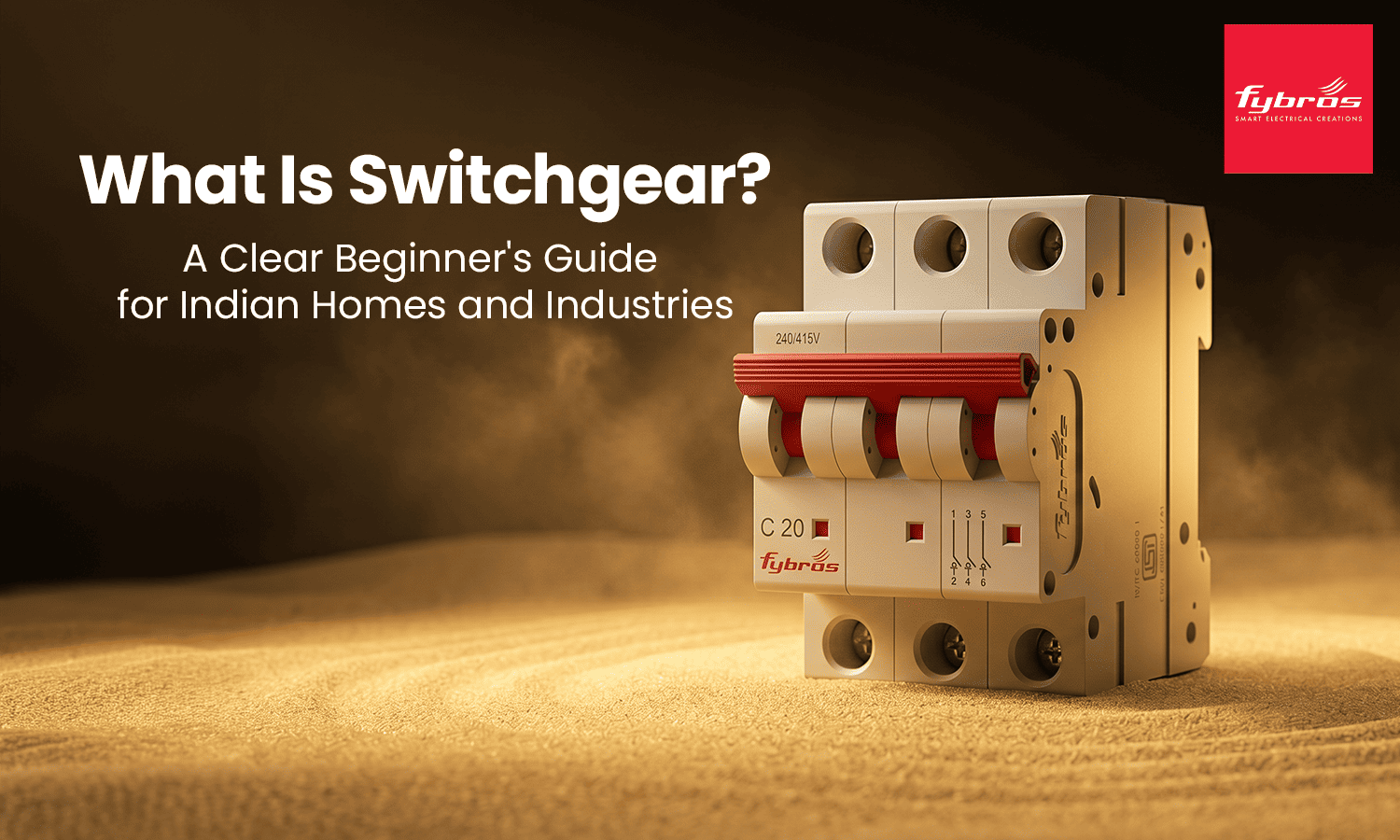
Ask ten people what switchgear is, and you will get eight blank stares and two confused guesses. Yet there is no part of a modern electrical installation more important. From a single MCB protecting your kitchen circuit to the metal-clad switchgear panel feeding an entire factory, these devices are what stand between a small electrical fault and a serious accident.
Definition of Switchgear
The simplest switchgear meaning is this: switchgear is the collection of devices that switch, control, and protect electrical circuits. When you flip an MCB to isolate a circuit before repairing a fan, you are operating electrical switchgear. When the same MCB trips automatically because a tool short-circuits, that is also switchgear protection doing its job.
Standards bodies put it more formally. The Indian Electricity Rules and IEC 60947 series describe switchgear electrical systems as electrical apparatus designed for switching, interrupting, and controlling electrical power, often combined with protection and monitoring functions. If you are wondering what a switchgear is in a formal sense, it is a broad term because it covers a family of devices, not a single product.
What Does Switchgear Actually Do?
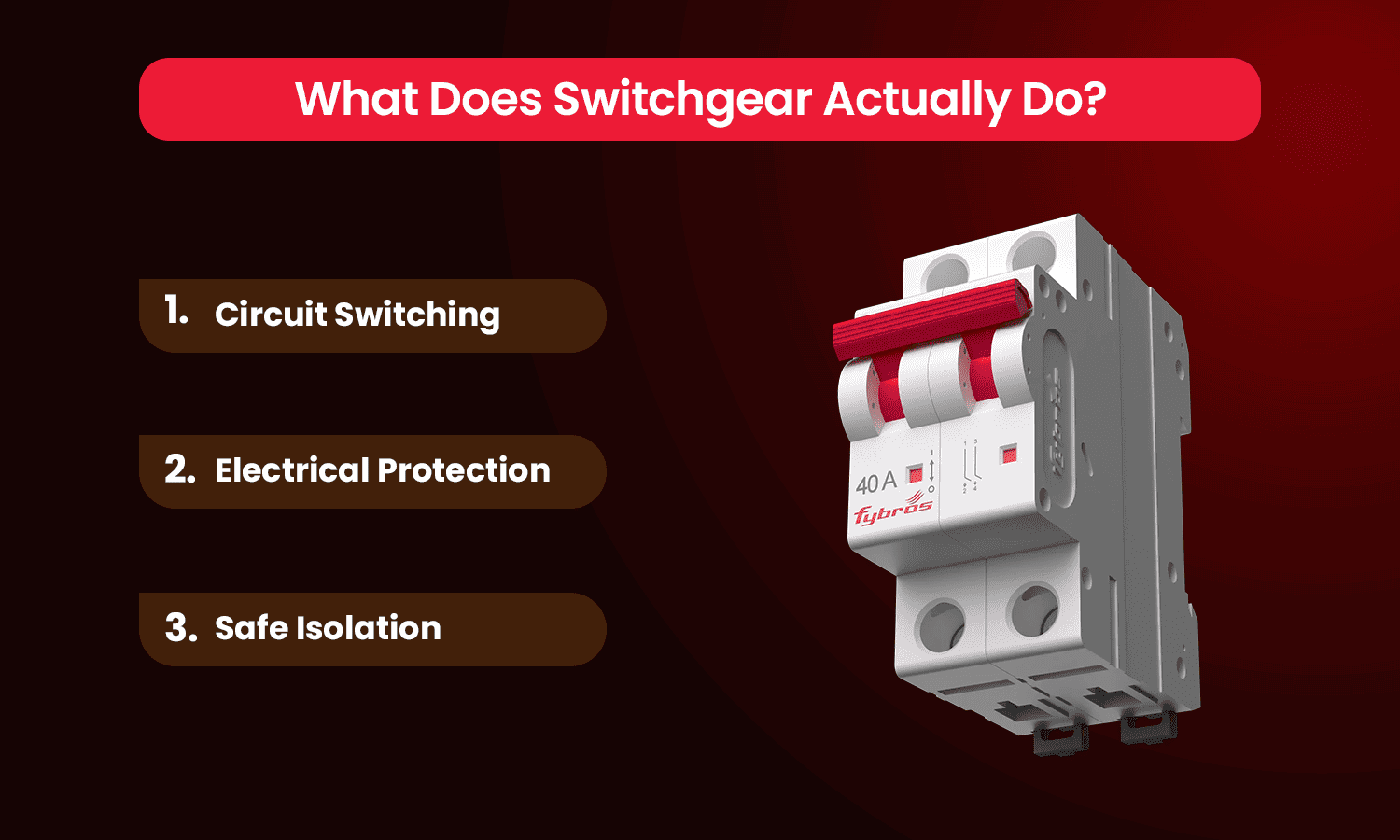
Three jobs sit at the center of every installation.
First, switchgear switches circuits on and off manually when you need to isolate equipment and automatically when a fault occurs.
Second, understanding what is switchgear in electrical systems requires looking at its protective role. The equipment contains the intelligence to detect overcurrent, short circuits, and earth leakage and to act in milliseconds before damage spreads.
Third, switchgear isolates parts of a network so engineers can work safely. A correctly designed assembly lets a technician de-energize one feeder while the rest of the building stays live.
The Most Familiar Switchgear in Your Home
If you have a distribution board in your flat or house, you already own switchgear. The miniature circuit breakers (MCBs) along the top of that board are low-voltage switchgear devices. The residual current circuit breaker (RCCB) next to them, usually a wider two-pole or four-pole unit, is also switchgear dedicated to detecting earth leakage and preventing electric shock.
Even the main isolator at the top of the board is switchgear. It is a manually operated switch that lets you cut all power to the installation in an emergency or during maintenance.
Industrial Switchgear: Same Idea, Bigger Stakes
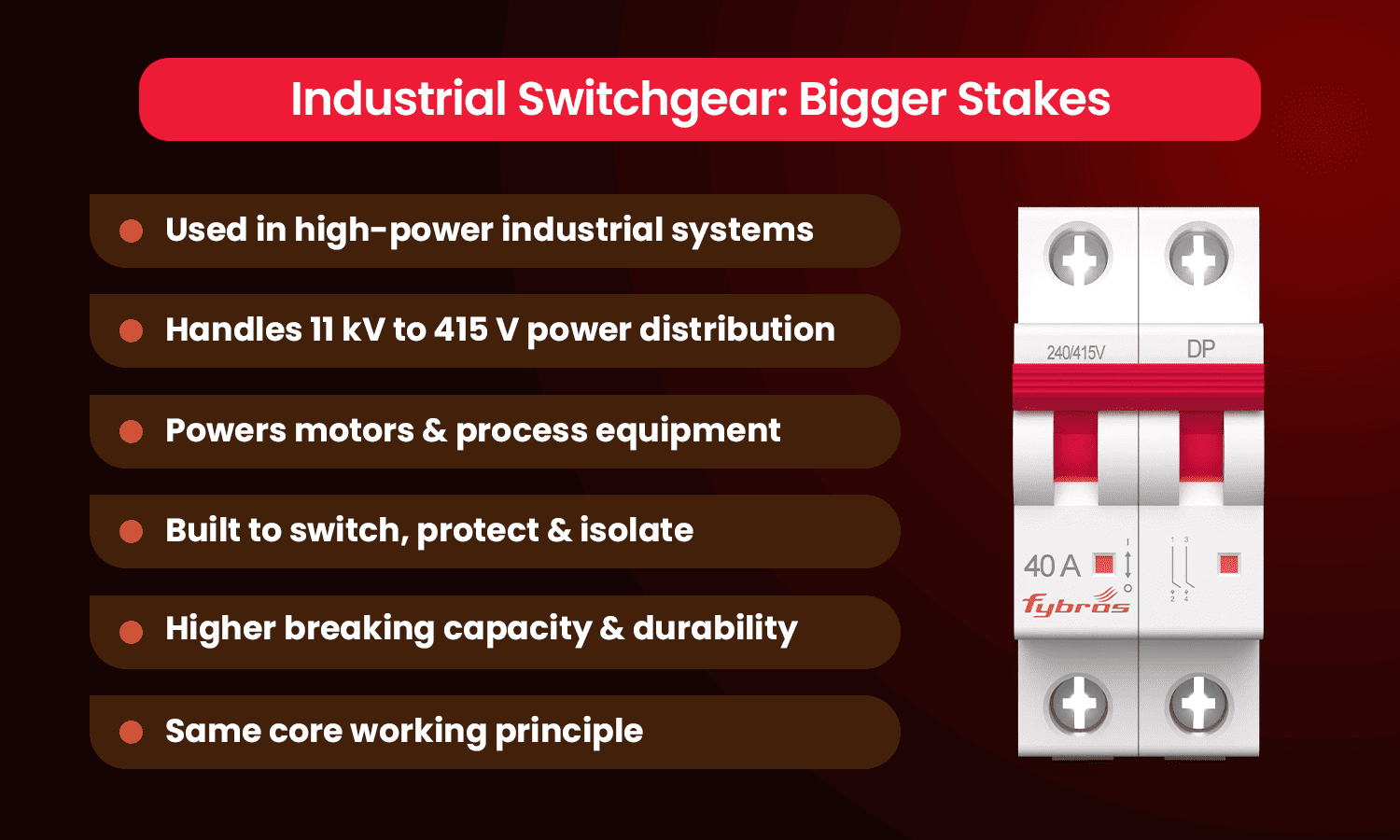
In an industrial setting, industrial switchgear scales up dramatically. A factory might have a main HT panel receiving an 11 kV supply, which often utilizes medium voltage switchgear to handle higher power loads. These systems then feed transformers that step power down to 415 V, where an LT lineup distributes power to motors and process equipment.
Every section is built around the same three jobs: switch, protect, and isolate. What changes in industrial systems is the breaking capacity, the size of the switchgear components, and the mechanical robustness. The principles remain identical.
Why Quality Switchgear Matters
Cheap, unbranded switchgear is one of the most common causes of preventable electrical accidents in India. A breaker that fails to trip on a short circuit, an RCCB that does not actually sense earth leakage, or an isolator that arcs when opened under load are not theoretical risks. They are the failure modes electricians see every week.
Choosing reliable switchgear products from reputable switchgear manufacturers in India is one of the highest-value decisions you can make for the safety of any building. When researching what is switchgear and its types, you will find that the price difference between premium and basic switchgear over the twenty-year life of an installation is trivial, but the difference in outcomes when a fault happens is enormous.
How Fybros Approaches Switchgear
Fybros is an Indian switchgear company with a manufacturing heritage rooted in electrical cables. The brand has expanded into MCBs, RCCBs, isolators, changeover switches, and distribution boards specifically designed for Indian conditions, including high ambient temperatures, dusty environments, and the wide voltage fluctuations common across the country.
The ARMOR Series MCBs, EVO GUARD Mini MCBs, and NUEVO Changeover Switches form the core of the Fybros lineup. Each product represents the various types of switchgear built to relevant IS/IEC standards and tested for the breaking capacities Indian installations actually need.
Final Word
What is Switchgear? It is not a luxury, an upgrade, or a technicality. It is the foundation of safe electricity use. Understanding what switchgear is and choosing the right switchgear for your home, business, or industrial site is one of the highest-leverage decisions in any electrical project.
If you are planning a new installation or upgrading an old one, talk to your electrician about specifying Fybros switchgear. It is built for the conditions you actually face and backed by a national presence that makes service, support, and spares straightforward.
A Day in the Life of an MCB
To make the abstract concrete, picture a single 16 A MCB sitting on the DIN rail of a Mumbai apartment's distribution board. At 7 AM, the geyser switches on and draws 12 A. The MCB is unbothered. At 8 AM, the resident plugs in an iron while the geyser is still running. Total current creeps to 15 A, which is still within rating. The bimetallic strip inside the MCB starts to warm but does not bend far enough to trip.
At 8:15 AM, a fault in the iron's cord shorts the live conductor to the earth. Hundreds of amperes flow for less than a hundredth of a second. The MCB's magnetic element, which is one of the vital internal switchgear components, snaps the contacts open before the cable can heat up. The lights elsewhere in the flat stay on because only this one circuit's MCB has operated. The resident resets it after replacing the iron, and life continues. This is what protection and switchgear actually do every day in millions of Indian homes.
How Standards Bodies Define the Term
Indian and international standards bodies have settled the switchgear definition. IEC 60050, the international electrotechnical vocabulary, defines the category as a general term covering switching devices and their combination with associated control, measuring, protective, and regulating equipment. The Bureau of Indian Standards mirrors this definition in IS publications that govern Indian manufacturing.
This formal definition matters in practice. When you are reading a tender document or a product datasheet, the legal meaning of these words is anchored to the standards. A device claiming to be a circuit breaker must meet specific making and breaking capacity tests. Whether you are installing a low voltage switchgear for a home or medium voltage switchgear for a commercial hub, the device must meet those tests. A device claiming to be a residual current device must trip within defined time bands.
These are not marketing claims. They are testable requirements that accredited laboratories verify before the product can carry the standard mark.
FAQs
1. What is switchgear in electrical systems?
What is switchgear in electrical systems is a common question among homeowners and business owners. Switchgear refers to a collection of devices used to switch, control, isolate, and protect electrical circuits. It helps prevent equipment damage, electrical faults, and safety hazards by disconnecting circuits when abnormal conditions occur.
2. What is switchgear and its types?
What is switchgear and its types can be understood by classifying switchgear according to voltage levels. The main types of switchgear include low voltage switchgear, medium voltage switchgear, and high voltage switchgear. Each category is designed for specific applications ranging from homes and offices to industrial plants and utility substations.
3. What are the main switchgear components?
The most common switchgear components include MCBs, RCCBs, MCCBs, ACBs, isolators, contactors, changeover switches, and distribution boards. These components work together to provide protection, switching, monitoring, and safe isolation of electrical circuits.
4. What is the difference between low voltage switchgear and medium voltage switchgear?
Low voltage switchgear is typically used in electrical systems up to 1000 V and is commonly found in homes, commercial buildings, and industrial facilities. Medium voltage switchgear is used in higher-voltage applications such as substations, factories, and large infrastructure projects where greater power handling capacity is required.
5. Why is it important to choose products from trusted switchgear manufacturers?
Trusted switchgear manufacturers design and test products according to recognized IS and IEC standards. Quality switchgear provides reliable fault protection, safer operation, longer service life, and better performance during short circuits, overloads, and earth leakage conditions. Properly certified products significantly reduce electrical safety risks.