Understanding how LED works is simpler than most people expect. An LED is a light-emitting diode, a tiny piece of semiconductor that gives off light when electricity passes through it. It turns almost all of its power straight into light and very little into heat, which is why it is so efficient.
LED lighting is everywhere now, but few people know what is actually happening inside the fitting. The good news is that the idea is not hard. Once you see how LED works, the reasons it lasts longer, runs cooler and saves power all make sense. This page explains the basics in everyday language, with no need for a physics degree or a wiring diagram.
The whole story comes down to one small part doing one clever thing. Let us start with what that part is.
The letters LED stand for light-emitting diode. A diode is a small electronic part that lets electricity flow one way, and a light-emitting diode is a special kind that gives off light while it does so. Answering what is light emitting diode really means describing this tiny chip, usually a few millimetres across, made from a material called a semiconductor. That small size is the reason LEDs can be built into everything from a slim panel to a strip to a bulb.
Inside the diode are two layers of semiconductor treated in slightly different ways. One layer has spare electrons and the other has spaces for them, called holes. When you connect power the right way round, electrons cross from one layer to the other. Each time an electron drops into a hole, it releases a tiny burst of energy as light. This is the heart of the led working principle, millions of these tiny releases happening at once to give a steady glow. Understanding how LEDs work really comes down to this single step, electrons meeting holes and giving off light.
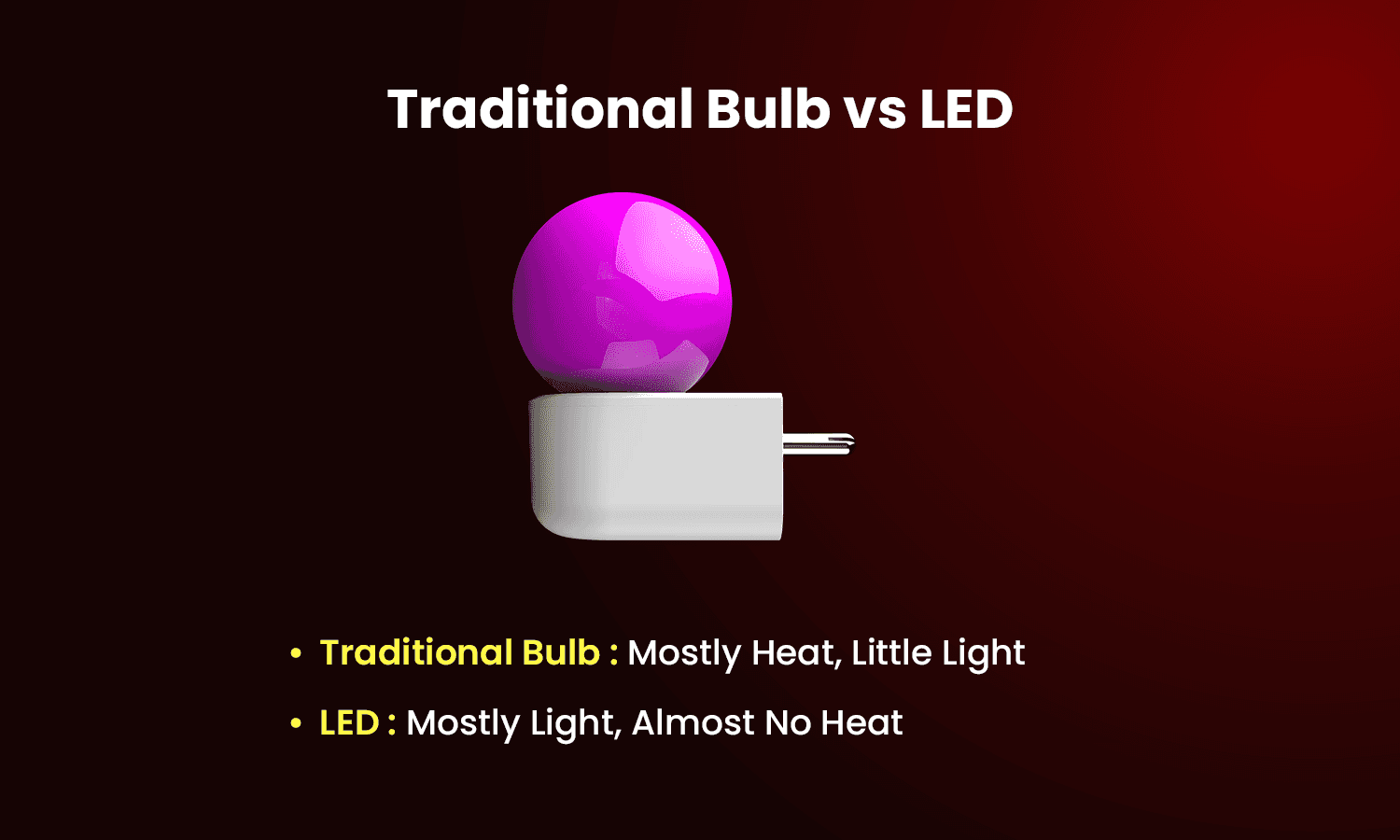
Old bulbs made light by heating a wire until it glowed, so most of their power became heat and only a little became light. An LED skips the heat step almost entirely, turning most of its power straight into light. That is the real reason it saves so much energy. As a widely quoted figure, LED lighting can use up to seventy five percent less power than the old incandescent bulbs and last far longer. A little heat still forms at the chip, which is why good fittings use a metal body to carry it away, but the surface stays far cooler than any filament lamp.
The colour an LED gives off depends on the exact material inside the chip. Different materials release their energy as different colours, which is how a single technology makes warm white, cool white, red, green and blue light. White LEDs usually start with a blue chip and add a coating that shifts the light to white. This is part of why LED lighting is so flexible, the same basic led technology can be tuned to feel cosy and golden or bright and daylight-like just by changing what is inside.
You may also have seen the term OLED, which stands for organic light-emitting diode. An organic light emitting diode uses a thin film of carbon-based material instead of a hard semiconductor chip, and it is mostly found in televisions and phone screens rather than room lighting. For home and office lighting, the standard LED is what you will meet. If you ever look up a light emitting diode symbol on a wiring plan, it is simply a diode symbol with two little arrows pointing away, showing that light is coming out.
It helps to stop picturing a bulb. An old bulb was mostly empty glass around a glowing wire, while an LED is a solid little chip on a small board with its driver. There is no fragile filament to snap and no gas to leak, which is a big part of why an LED survives knocks and switching far better. Seeing how LED works as solid-state electronics, rather than a heated wire, explains its long life. It is closer to a phone chip than to a candle, and it is built to keep going for years.
Knowing how LED works helps you buy better. It explains why a metal-bodied fitting lasts longer, because it manages the little heat that forms. It explains why wattage no longer means brightness, because LEDs make far more light per watt. And it explains why colour is a real choice, since the chip can be tuned to any tone. With this basic idea in hand, the different types of LED lights and their features are much easier to compare.
1. How does an LED actually make light?
An LED makes light when electrons move across a tiny semiconductor and release energy as light rather than heat. That is the short version of how LED works. There is no filament to heat and no gas to excite, just electrons giving off light directly, which is why an LED is so efficient and long-lasting.
2. What does LED stand for?
LED stands for light-emitting diode. A diode lets current flow one way, and a light-emitting diode gives off light as it does. It is a small semiconductor chip, which is why LEDs can be built into slim panels, strips, spotlights and bulbs of almost any shape and size.
3. Does an LED get hot?
Only a little, and only at the chip. Because of how LED works, most of the power becomes light rather than heat, so an LED runs far cooler than an old bulb. A good fitting uses a metal body to move that small amount of heat away, which helps it last for years.
An LED is a light-emitting diode, a tiny semiconductor chip that gives off light when current flows through it.
It makes light when electrons meet holes and release energy directly, which is the core of how LED works.
Because it skips the heat step, it can use up to seventy five percent less power than an old bulb.
The colour depends on the material inside, so one technology makes warm, cool and coloured light.
Knowing the basics helps you value a metal body, ignore old wattage habits and choose colour on purpose.
Now that the technology makes sense, the fun part is choosing. See the full Fybros lighting range and pick fittings that put good, efficient LED light exactly where you want it. Visit fybros.com or ask your nearest Fybros dealer to plan your rooms.

 Fans
Fans
 Switches & Accessories
 Led Lighting
 Wires & Cables
 Switchgear