
 Fans
 Switches & Accessories
 Led Lighting
 Wires & Cables
 Switchgear
10 Pooja Room Lighting Ideas and a Complete Guide for 2027
Quick answer
The best pooja room lighting is soft, warm and glare-free: a gentle ambient light for the whole space, one focused light on the idol, and an optional hidden strip for a soft halo. Use warm white LED at 2800 to 3000K and hide the light source from direct view. Avoid cool white, and never put a bright light directly behind the idol.
This guide is for anyone planning or refreshing a pooja room, from a corner shelf to a dedicated room. It explains how to layer the light, which colour suits worship, ten lighting ideas, the best LED lights for the job, how to adapt the plan to your room, mistakes to avoid and how to install everything safely.
Pooja Room Light Design: How To Plan The Lighting
Good pooja room light design is about the right light in the right place, not more light. Decide the layers first, then buy.
The Three Layers: Ambient, Focus And Decorative
-
Ambient light is the soft overall glow that fills the room without glare.
-
Focus light is one gentle beam on the idol, so the eye goes to the deity first.
-
Decorative light is a warm strip, lamp or diya that adds warmth around the mandir.
A calm pooja room uses all three, kept low and warm. A small corner may only need two.
| Colour temperature | Look | Use it for |
|---|---|---|
| 2800 to 3000K (warm white) | Close to a diya flame | Everything in the pooja space |
| About 4000K (natural white) | Clearer and brighter | A reading light for texts, if needed |
| 6500K (cool white) | Clinical | Avoid in the pooja room |
How Many Lights And What Wattage?
These are the LED light options for a pooja room worth considering, with the role each one plays. The Fybros products are available across the Fybros range.
| Space | Ambient | Focus | Decorative |
|---|---|---|---|
| Small corner or shelf | One warm bulb, 5 to 7W | One small spot, about 3W | Diyas |
| Wall-mounted mandir | Warm surface light, 6 to 9W | One spot or two small pendants | Hidden strip behind the frame |
| Dedicated room | Warm surface or panel light, 6 to 12W | One or two COB spots | Strip and a hanging lamp |
Keep every source soft. Glare, not lack of light, is the common problem.
Pooja Room Lighting Ideas
Choose one or two ideas from different groups. You rarely need all ten.
Ceiling Lights
1. Recessed Cob Downlights Around The Mandir
-
What you need: two or three small recessed COB downlights in the ceiling or false ceiling.
-
Approx. cost: Fybros range.
-
Tip: Place them slightly in front of the mandir, in line with its edges, and angle them inward. The light then falls on the front and sides of the mandir instead of glaring straight down.
2. A Warm Surface Or Panel Light Above The Pooja Area
-
What you need: a Fybros Moon Striker surface light in the warm white option, or a slim panel light.
-
Approx. cost: Fybros range.
-
Tip: One light centred over the space is enough. Check that it is the warm option, around 2800K, so it matches the diyas below.
Spotlights for the idol
3. A Focused Spotlight On The Idol
-
What you need: a Fybros COB spotlight (Sirio or PACE) in warm white.
-
Approx. cost: Fybros range.
-
Tip: Aim it from the front and slightly above, at an angle, not straight down. This lights the face and shoulders without hot spots or deep shadows under the chin.
4. An Adjustable Track Spot For Several Idols
-
What you need: a Fybros COB spot
-
Approx. cost: Fybros range.
-
Tip: A track suits a mandir with several idols or shelves, because each beam can be aimed separately. Test the angles after dark, when you will actually use them.
Hanging lights
5. A Hanging Lamp Above The Mandir
-
What you need: a single brass or decorative pendant with a warm LED bulb inside.
-
Approx. cost: Rs 500 to 2,000
-
Tip: Hang it high enough to clear raised hands during aarti. Keep it centred over the mandir and away from the diya flame.
6. A Pair Of Pendants For A Wider Mandir
-
What you need: two matching small pendants.
-
Approx. cost: Rs 800 to 2,500
-
Tip: Hang both at the same height and the same distance from the centre. Uneven pendants look careless against a symmetrical mandir.
Traditional And Decorative Light
7. Brass Diyas And Oil Lamps
-
What you need: brass diyas and oil.
-
Approx. cost: Rs 100 to 300 a dozen.
-
Tip: Place them low and in front of the idol on a steel or stone tray, away from wires, strips, garlands and cloth. Let the electric lights stay in the background.
8. Warm Led Bulbs In Lamp Holders
-
What you need: warm white Fybros LED bulbs (2800 to 3000K) in decorative lamp holders.
-
Approx. cost: Fybros range.
-
Tip: This gives the look of a lamp with no flame to watch overnight. Check the holder type and use bulbs rated for enclosed fittings if the holder is closed.
9. A Warm Strip Behind The Mandir
-
What you need: a Fybros F-GLO LED strip along the back edge of the mandir frame.
-
Approx. cost: Fybros range.
-
Tip: Fix it facing the wall, so the wall glows and the strip itself is hidden. Use the warm setting for daily prayer. If you have the tri-colour strip, switch tones for festivals.
10. A Night Lamp For Early Mornings
-
What you need: a Fybros Nuit night lamp.
-
Approx. cost: Fybros range.
-
Tip: A small low-level glow lets you enter the pooja area at dawn without switching on the main light. Keep it away from diyas and cloth.
Best Led Lights For Pooja Room: A Product Guide
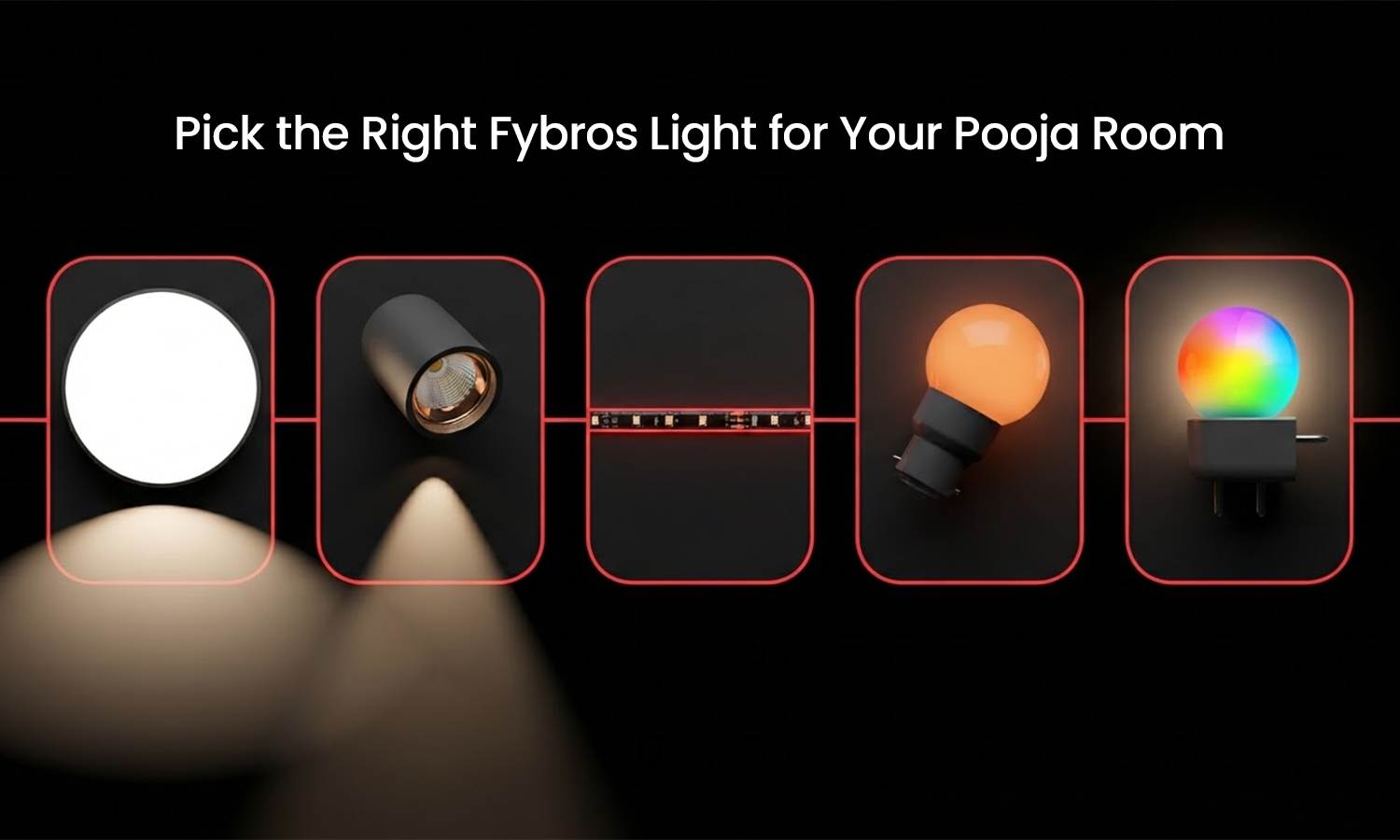
| Light | Typical wattage | Colour | Best for | Price |
|---|---|---|---|---|
| Fybros warm LED bulb | 5 to 9W | Warm white, 2800 to 3000K | Ambient light and lamp holders | Fybros range |
| Fybros Moon Striker surface or panel light | 5 to 18W | Warm white | Ceiling ambient glow | Fybros range |
| Fybros COB spotlight (Sirio, PACE) | 3 to 7W | Warm or neutral | Focus on the idol | Fybros range |
| Fybros F-GLO LED strip | 12 to 48W per reel | Warm or tri-colour | Halo behind the mandir, shelf accents | Fybros range |
| Fybros Nuit night lamp | About 0.5W | Soft warm | Gentle overnight glow | Fybros range |
Pooja Room Lighting By Room Type
-
Small corner or shelf: one warm bulb for ambient light and one small spot on the idol. Keep both hidden from direct view.
-
Wall-mounted mandir: a spot or a pair of pendants above it, and a strip behind the frame for depth. This takes no floor space.
-
Dedicated pooja room: a warm surface or panel light for ambient, one or two COB spots for focus and a hidden strip, all on warm white.
-
Apartment: neat recessed or surface lights and strips work best, because ceiling height and wiring are often limited.
-
Independent house: there is room for a hanging lamp and more layers, but keep the total light low and warm.
Mistakes To Avoid
-
Glare: a bare bulb in the line of sight spoils the calm. Hide the source or use a diffuser.
-
Cool white light: at 6500K it looks harsh and makes brass and flowers look flat.
-
A bright light behind the idol: it turns the deity into a silhouette. Light the front and sides.
-
Reflections: marble, glass and polished brass bounce light back at you. Move the spot to one side and check from where you stand to pray.
-
Mixed colour temperatures: a warm bulb with a cool strip looks uneven. Keep everything at 2800 to 3000K.
-
Flames near wiring: keep diyas and oil lamps away from strips, wires and fabric.
Safety And Installation
Pooja rooms have open flames, cloth, flowers and electricity close together, so a few rules matter.
Before You Install
-
Switch off the power at the MCB before working near wiring or metal.
-
Check every strip, cable and adaptor for cuts and loose joints. Don’t use damaged ones.
While You Install
-
Don’t run several lights through a cheap splitter on one socket.
-
Fix strips and spots with clips or proper mounts, never with a nail through the wire.
-
Keep adaptors off the floor and away from oil and water.
Around Flames
-
LED lights run much cooler than filament bulbs, which helps near cloth and flowers. They do not make an open flame safe.
-
Keep diyas, camphor and incense away from wiring, strips and garlands, and never leave a lit lamp unattended.
Permanent Fittings
-
For recessed lights, a surface light or a permanent strip, ask a qualified electrician to make the final connection. An MCB protects wiring from overload, and an RCCB protects people from shock.
-
After switching on, check after a few minutes that plugs and adaptors are not hot.
Pooja Room Lighting On A Budget
Low: A Simple Warm Glow
One warm Fybros LED bulb for ambient light and a few brass diyas. Add a small warm strip if you want a soft halo.
Mid: A Layered Look
Add a Fybros COB spot on the idol and a warm surface light above. The space now has a clear focus and an even glow.
High: A Finished Design
Combine recessed COB downlights, a Moon Striker surface light, a hidden F-GLO strip for a halo, a hanging lamp and a Nuit night lamp. This suits a dedicated pooja room that you want to look designed.
Festival Lighting For The Pooja Room
During festivals the pooja room needs a little extra warmth, not extra brightness. A tri-colour F-GLO strip set to a festive tone, a few extra diyas and a warm hanging lamp are usually enough. For full festive looks, see our Navratri decoration guide, Ayutha Pooja decoration guide and Saraswathi Pooja decoration guide.
FAQs
1. Which light is best for a pooja room?
A soft warm white LED. Use a gentle ambient light plus one focused spot on the idol. A warm surface light and a small COB spot give a calm glow without glare.
2. Which colour light is best for a pooja room?
Warm white at 2800 to 3000K. It is close to the colour of a diya and shows brass, flowers and faces naturally. Avoid cool white at 6500K, which looks harsh in a space meant for prayer.
3. How many lights does a pooja room need?
A small corner needs two: a warm ambient bulb and a small spot on the idol. A dedicated room usually suits three or four: an ambient surface light, one or two focus spots and a hidden strip.
4. Can LED lights be used near diyas?
Yes, with care. LEDs stay much cooler than filament bulbs, which makes them a better choice near cloth and flowers. They don’t make an open flame safe, though. Keep diyas and oil away from wiring and strips, and never leave a lit lamp unattended.
5. How do I light a small pooja corner?
Use one warm LED bulb for ambient light and one small spot on the idol. Hide both from direct view and keep them on warm white.
6. How do I avoid glare on a marble or glass mandir?
Move the spot to one side and aim it at an angle, not straight at the surface. Use a diffused warm light for ambient, and check the reflections from where you stand to pray.
Light up your pooja room with Fybros
Warm, soft and focused light makes a pooja room feel devotional every day, and it lifts gently for a festival. Combine a warm ambient light, a spot on the idol and a hidden strip. Explore Fybros warm bulbs, COB spotlights, Moon Striker surface lights and F-GLO strips, or find your nearest Fybros store.