
 Fans
Fans
 Switches & Accessories
 Led Lighting
 Wires & Cables
 Switchgear
What Is the Tubelight Price in India? (2026 Complete Guide)
If you are planning to replace or buy a new light, the first question that comes up is always the tubelight price. In India, tubelights are still one of the most common lighting choices for homes, offices, and shops. What has changed is the technology and the pricing.
In 2026, LED tubelights had almost fully replaced older fluorescent models. The price now depends on factors like wattage, length, brand, and added features such as color modes or surge protection. This guide breaks down tubelight pricing in India using real numbers, clear examples, and simple explanations so you know exactly what you are paying for.
What Is a Tubelight and Why Is It Widely Used in India?
A tubelight is a long, linear light source that provides even illumination across a room. Earlier, this meant glass fluorescent tubes. Today, it mostly refers to LED battens.
Tubelights became popular in India because a single light could brighten an entire room evenly. They are also known for durability and low maintenance. Modern LED versions are safer, more efficient, and easier to install than older electric tubelight systems with chokes and starters. By 2026, nearly 90 percent of the Indian market will have shifted to LED tubelights.
Current Tubelight Price in India
As of 2026, the tubelight price in India for LED models generally ranges from ₹100 to ₹700 per unit. The variation depends on brand, wattage, and features.
For a standard household, a 4-foot LED batten in the 20W to 22W range usually costs between ₹120 and ₹600. Budget brands sit at the lower end, while premium brands with better protection and finish are priced higher. When comparing tubelight cost, it is important to look beyond just the sticker price and consider lifespan and efficiency.
LED Tubelight Price vs Fluorescent Tubelight
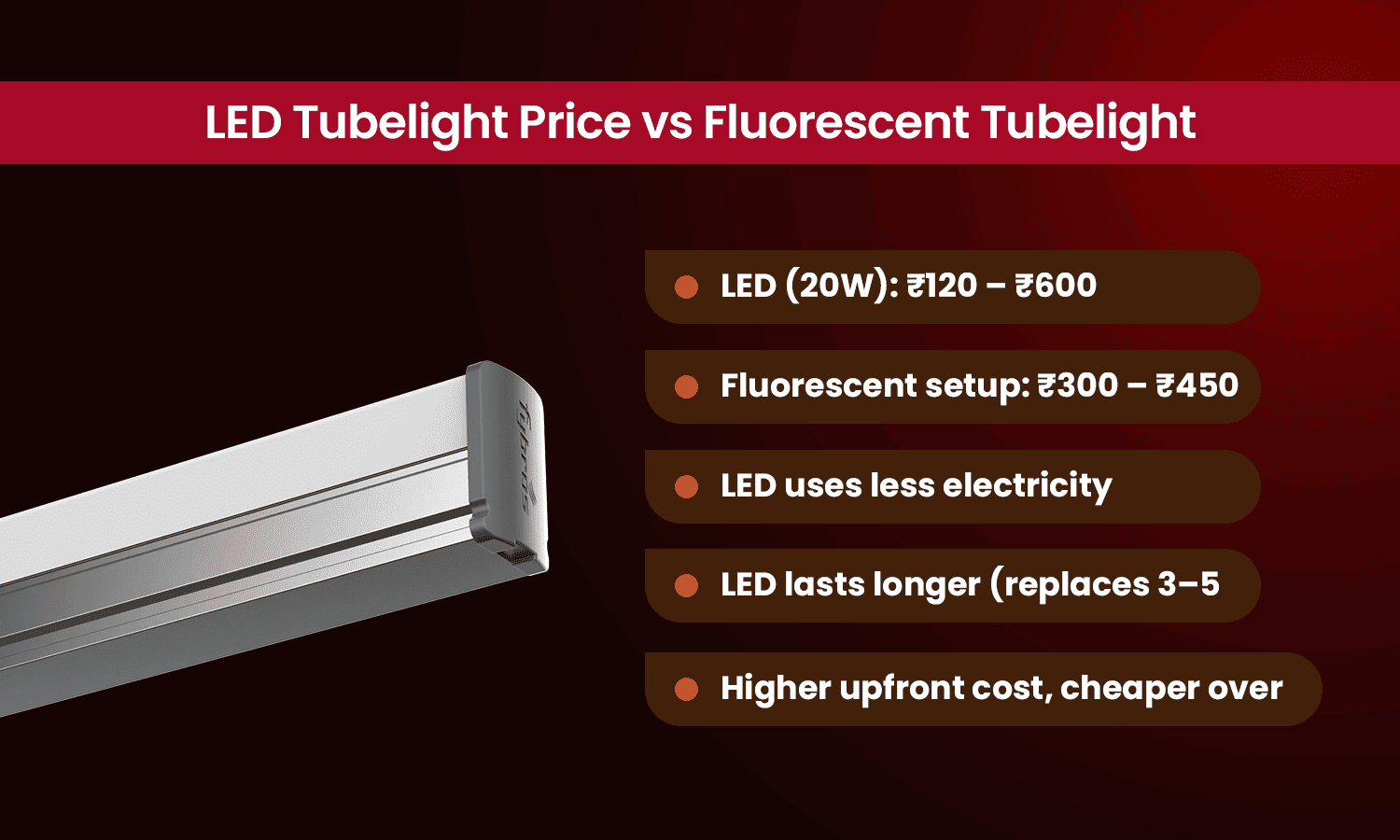
LED tubelights cost more upfront but are cheaper over time. A standard LED batten (20W) typically costs ₹120 to ₹600, while a fluorescent setup (tube, ballast, and starter) costs around ₹300 to ₹450.
The difference becomes clear in usage. LED tubelights use far less electricity and last much longer. A single LED can replace three to five fluorescent tubes over its lifetime. This makes the led tubelight price far more reasonable when looked at over several years rather than one purchase.
Tubelight Price by Size
Tubelight pricing also depends on physical length. The most common sizes used in India are 1-foot, 2-foot, and 4-foot lights.
|
Tubelight Length |
Common Wattage |
Typical Price Range |
|
1 foot |
5W–8W |
₹100 – ₹280 |
|
2 feet |
10W–12W |
₹180 – ₹499 |
|
4 feet |
18W–24W |
₹120 – ₹600+ |
A small tubelight is usually used for wardrobes, cabinets, or focused lighting. Four-foot models remain the most common choice for rooms and kitchens.
Tubelight Price by Wattage
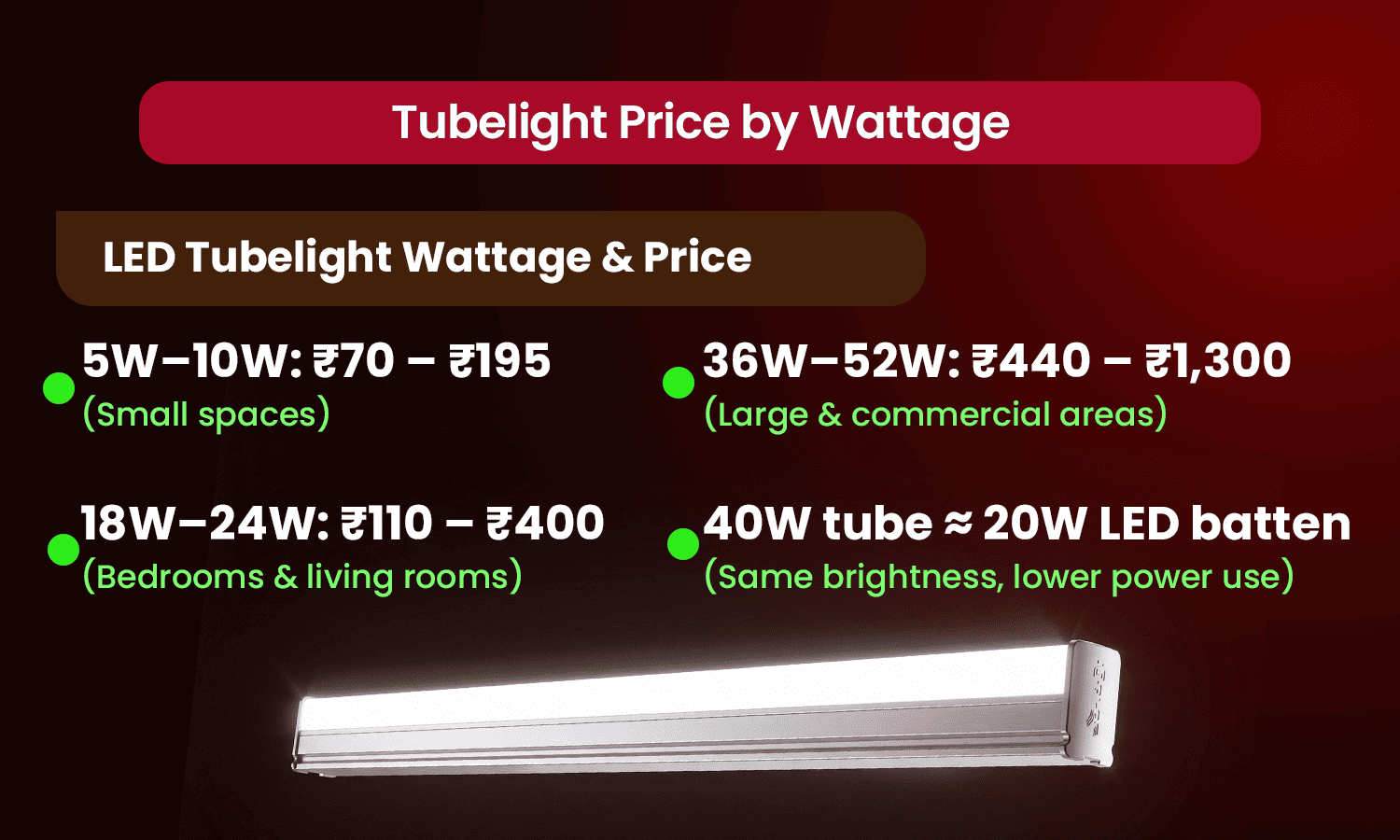
Wattage plays a direct role in pricing and brightness. Here is how prices usually break down in 2026:
-
5W to 10W: ₹70 – ₹195, used for cabinets and small spaces
-
18W to 24W: ₹110 – ₹400, used for bedrooms and living rooms
-
36W to 52W: ₹440 – ₹1,300, used for halls and commercial areas
A tubelight 40 watt equivalent today is usually replaced by a 20W LED batten, delivering similar brightness at much lower power consumption.
Choosing the Best Tubelight at the Right Price
Choosing the right tubelight is about matching your room needs with value.
Start by checking brightness. For most rooms, 18W to 22W LED tubelights are sufficient. A 20W model generally provides around 2,000 lumens, enough for bedrooms and halls. This makes it a common choice for the best tubelight for home use.
Next, choose the light color. Cool White is popular for kitchens and work areas, Natural White works well for general use, and Warm White suits bedrooms and living rooms. Also compare build quality, surge protection, and warranty instead of only focusing on price.
Is an LED Tubelight Worth the Price?
Yes, LED tubelights are worth the price in 2026. Although the initial tubelight led price may feel higher, the savings start within months. Replacing one fluorescent tube with an LED can save ₹30 to ₹50 per month on electricity bills.
LED tubelights also avoid frequent replacements, humming noise, and flickering issues. Over time, they cost much less to own while offering better lighting comfort.
Brand Example: Fybros Tubelight Pricing in 2026
Brands like Fybros focus on LED batten lighting designed for Indian conditions. Their pricing sits in the mid-range category.
-
5W models: ₹186–₹195
-
10W models: ₹259
-
20W–22W models: ₹180–₹350
-
45W models: ₹689
They also offer multi-packs that reduce per-unit cost, making them practical for full-home lighting upgrades. Options include neutral designs as well as fancy tubelight variants with color-changing modes.
Key Takeaways
-
Tubelight price in India ranges from ₹100 to ₹700 in 2026
-
LED tubelights cost more upfront but save money long-term
-
4-foot, 20W models are the most common household choice
-
Price depends on wattage, size, and added features
-
Buying in packs reduces overall cost
FAQs
1. What Are Light Tubes Used For?
Light tubes are used for general room lighting, kitchens, offices, and corridors. Smaller sizes are also used for cabinets and wardrobes. In modern homes, they are common as tubelight for living room lighting when paired with neutral or warm tones.
2. Are LED Tube Lights Dimmable?
Some LED tubelights are dimmable, but not all. Dimmable models require compatible drivers or smart systems. Always check specifications before you buy an LED tube light if dimming is important.
3. Are LED Tube Lights Safe?
Yes, LED tubelights are safer than fluorescent tubes. They are mercury-free, operate at lower heat, and are usually made of durable polycarbonate instead of glass.
4. Why Is My LED Tube Light Flickering or Blinking?
Flickering is usually caused by wiring issues, incompatible dimmers, or unstable voltage. Models with built-in surge protection handle fluctuations better.
5. Are LED Tube Lights Harmful for Eyes?
Good-quality LED tubelights are not harmful to eyes. They provide steady light without buzzing or visible flicker. Choosing the right color temperature helps reduce eye strain.